
Pair your lentils with a squeeze of lemon. Drink orange juice with your fortified cereal. It is one of the most repeated pieces of nutrition advice, and unlike most food-pairing rules, it rests on decades of controlled human research.
But the same body of research contains a second finding that is repeated far less often, and it complicates the first one considerably.
Vitamin C reliably increases the absorption of non-heme iron from a single measured meal. Across a whole diet eaten over days, the same effect has been much harder to detect.
Both statements come from the same researchers, using the same isotope methods. Neither cancels the other. What separates them is the question being asked — and that distinction is the real subject of this article.
So the useful question is not “Does vitamin C boost iron?”
It is:
“Under what conditions does vitamin C meaningfully change how much iron your body takes up?”
Quick answer
Yes. Vitamin C is the most effective known enhancer of non-heme iron absorption, and its effect is largest in exactly the meals where iron absorption would otherwise be poorest.
It works by converting dietary iron into a more absorbable form and keeping it soluble long enough to be taken up. It can counteract the inhibitory effects of phytate, polyphenols, and the calcium and proteins in dairy.
However, this is an absorption effect measured in single meals. When researchers measured iron absorption from complete diets over several days, they found no significant difference across a wide range of vitamin C intakes — and prolonged vitamin C supplementation has not been shown to improve iron status.
Vitamin C is also fragile. Cooking, processing and storage degrade it and remove its enhancing effect.
Interaction at a glance
| Subject A | Vitamin C (ascorbic acid) |
|---|---|
| Subject B | Iron |
| Relationship | Vitamin C enhances absorption of non-heme iron |
| Main context | Vitamin C consumed in the same meal as the iron |
| Most affected form | Non-heme iron, from plants and fortified foods |
| Mechanism | Reduces ferric iron to the more absorbable ferrous form, and chelates iron to keep it soluble |
| Evidence | Well established in single-meal isotope studies |
| Important nuance | The effect is far less pronounced when measured across a complete diet |
| Fragility | Heat, processing and storage degrade vitamin C and remove the effect |
| Big distinction | Enhanced absorption from a meal ≠ improved iron status over time |
What are iron and vitamin C?
What is iron?
Iron is an essential mineral. It forms part of hemoglobin, the protein in red blood cells that carries oxygen, and it is involved in myoglobin, enzyme function and cellular energy production.
Dietary iron comes in two forms, and the difference matters more than almost anything else in this article:
- Heme iron — found in meat, seafood and poultry. Absorbed relatively efficiently and largely shielded from the rest of the meal.
- Non-heme iron — found in beans, lentils, leafy greens, nuts, seeds, grains, eggs and iron-fortified foods. Its absorption is highly variable and strongly influenced by everything else on the plate.
Non-heme iron typically arrives in the ferric form (Fe³⁺), which is poorly soluble at the pH of the small intestine unless something keeps it in solution. That chemical inconvenience is the opening that vitamin C exploits. If this distinction is new to you, our explainer on the difference between heme and non-heme iron covers it in more depth.
What is vitamin C?
Vitamin C, or ascorbic acid, is a water-soluble vitamin found in citrus fruits, strawberries, kiwifruit, bell peppers, broccoli, tomatoes and many other fruits and vegetables.
Two of its chemical properties matter here, and they are unrelated to its more familiar roles:
- It is a reducing agent — it donates electrons, converting ferric iron into ferrous iron.
- It is a chelator — it binds iron into a soluble complex.
Reviewing the enhancers of iron absorption, researchers have described ascorbic acid as the most efficient enhancer of non-heme iron absorption, with its effect stronger than that of other organic acids precisely because of its ability to reduce ferric to ferrous iron.
How can vitamin C affect iron absorption?
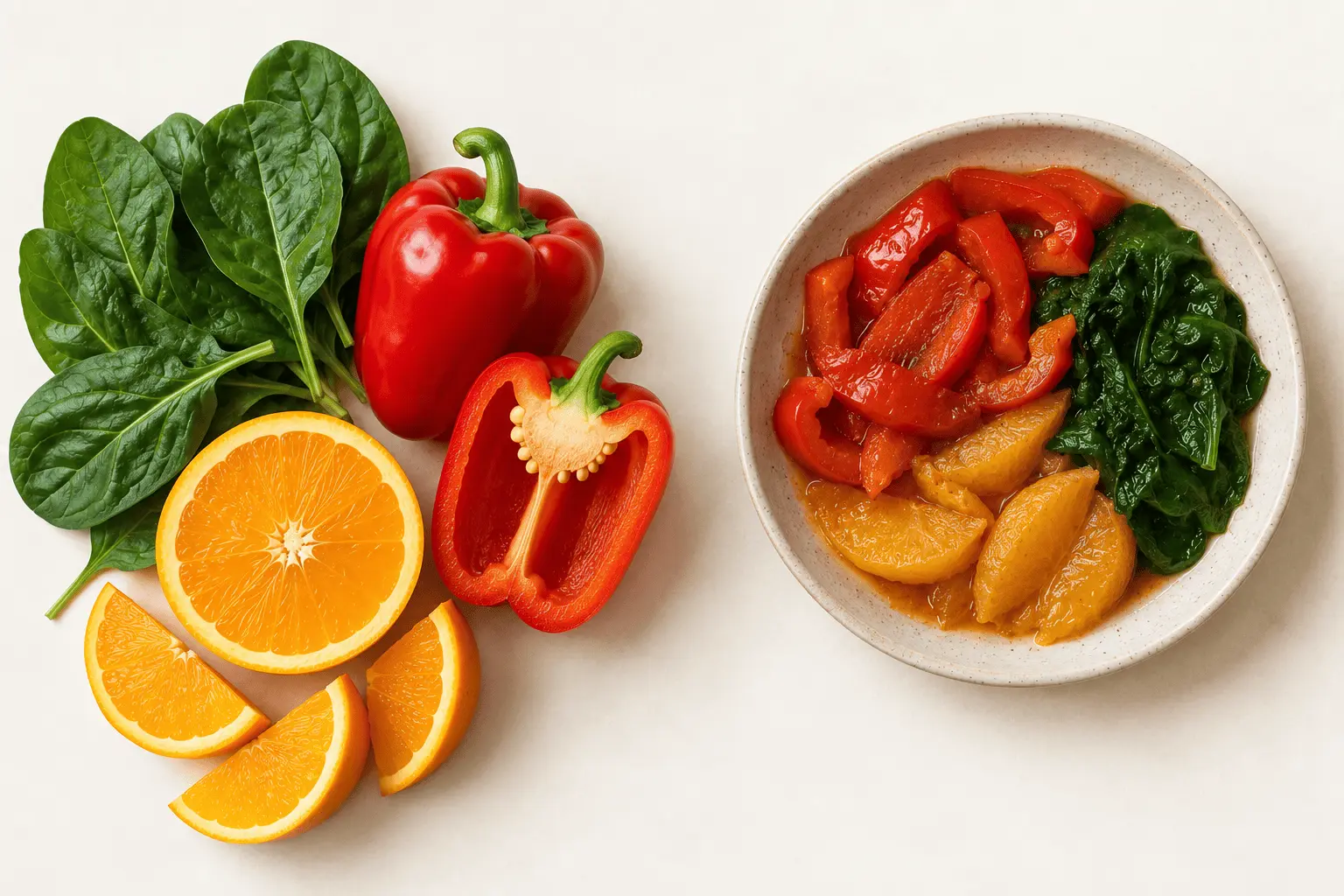
The interaction happens during digestion, in the space of a single meal.
Iron dissolves readily in the acidic environment of the stomach. The problem comes next. As stomach contents pass into the duodenum the environment becomes far less acidic, and ferric iron tends to precipitate out of solution — at which point it cannot be absorbed, however much of it the meal contained.
Ascorbic acid intervenes at both stages. It reduces ferric iron to the ferrous form that the intestinal transporter can take up, and it binds iron into a soluble complex that survives the shift in pH.
Vitamin C
increases absorption of
Non-heme iron
Vitamin C eaten in the same meal keeps non-heme iron in a soluble, absorbable form as it moves from the stomach into the small intestine. The relationship runs one way: iron does not affect vitamin C.
The sequence looks like this:
- Meal contains non-heme iron and vitamin C
- Ferric iron is reduced to the ferrous form
- Iron stays soluble as pH rises in the duodenum
- More iron is available for uptake from that meal
There is a third consequence that follows from the first two. Because ascorbic acid competes for iron against compounds that would otherwise bind it, it can neutralize the meal’s inhibitors — which is why its measured effect is largest in the meals where absorption would otherwise be worst.
Which inhibitors can vitamin C overcome?
This is the part of the interaction with the strongest support, and it is genuinely useful to know.
Reviewing iron bioavailability for dietary reference values, Hurrell and Egli concluded that ascorbic acid will overcome the negative effect on iron absorption of all inhibitors — including phytate, polyphenols, and the calcium and proteins in milk products — and will increase the absorption of both naturally occurring and fortification iron.
Those three inhibitors cover most of what the Atlas documents elsewhere: the phytate in whole grains and legumes, the polyphenols in tea and coffee, and calcium from dairy. Vitamin C is the one dietary factor that pushes back against all of them.
It also has a particular significance for people eating little or no meat. Ascorbic acid is the only main absorption enhancer in vegetarian diets, since the other well-documented enhancer is meat itself.
Does the amount matter?
Yes, and the relationship is not a simple “more is better.”
What matters is the ratio of vitamin C to iron in the meal, and how many inhibitors that meal contains. Reviewing the fortification literature, Teucher and colleagues reported that meals containing low to medium levels of inhibitors require ascorbic acid at a molar ratio of about 2:1 — roughly 20 mg of vitamin C per 3 mg of iron.
Meals with high levels of inhibitors are a different matter. To promote absorption there, the same review noted that ascorbic acid needs to be added at a molar ratio in excess of 4:1 — a quantity the authors described as potentially impractical.
That is an important limit. In a meal heavy with inhibitors, the amount of vitamin C needed to fully counteract them may be more than a normal serving of food provides.
These ratios come from fortification research, where the goal is to engineer a product with predictable absorption. They are not a target for anyone to calculate at breakfast.
Does cooking destroy the effect?
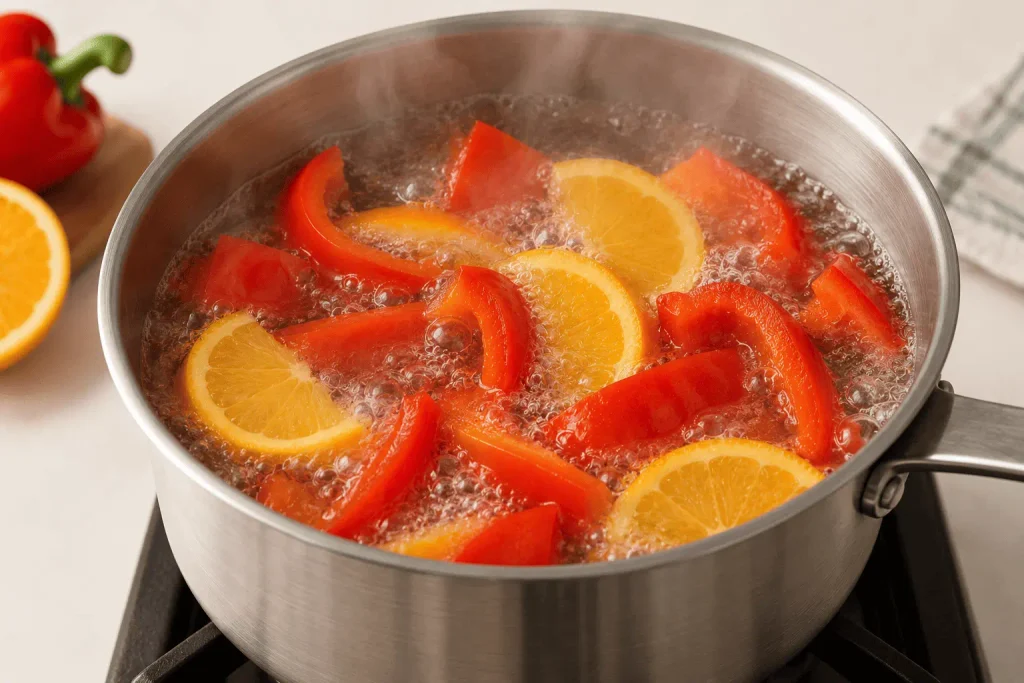
Largely, yes — and this is the most underappreciated part of the interaction.
Vitamin C is fragile. It is water-soluble, heat-sensitive and degrades on exposure to oxygen. Cooking, industrial processing and storage all degrade ascorbic acid and remove its enhancing effect on iron absorption.
The chemistry does not change. What changes is how much ascorbic acid is still present by the time the food reaches the plate.
The practical implication is unusually clear for a nutrition interaction:
A raw or lightly cooked source of vitamin C delivers more of the effect than a long-simmered one.
Do vitamin C foods always help?
Not necessarily, and this nuance is rarely mentioned.
Fruits and vegetables contain vitamin C, but many of them also contain polyphenols — the same class of compounds that inhibits non-heme iron absorption. Hurrell and Egli noted that in fruits and vegetables, the enhancing effect of ascorbic acid is often cancelled out by the inhibiting effect of polyphenols.
So a food is not automatically an iron enhancer simply because it is a good source of vitamin C. Its net effect depends on what else it brings to the meal.
This is a useful corrective to the way the advice is usually given. “Add a vitamin C food” is a reasonable heuristic, but it is a heuristic — not a chemical guarantee.
What other factors influence the interaction?
Your iron status
The body has no route for excreting iron, so it regulates iron balance at the point of absorption. Someone with depleted stores absorbs a larger fraction of available iron; someone replete absorbs less.
That regulation runs quietly underneath every meal, and it is one reason a percentage increase measured in a study does not translate directly into a personal benefit.
The form of iron in the meal
Vitamin C acts on non-heme iron. Heme iron enters the intestinal cell by a separate route and is far less sensitive to dietary factors, so a meal built around meat gains much less from added vitamin C than a meal built around lentils.
The rest of the meal
Because vitamin C’s largest measured effects come from counteracting inhibitors, the same amount of vitamin C does more in a phytate-rich meal than in one with few inhibitors to begin with. The interaction is a relationship between three things — iron, vitamin C, and everything else on the plate.
What does the evidence show?
The single-meal evidence is about as solid as nutrition evidence gets. Controlled studies using radiolabeled and stable iron isotopes have repeatedly shown that adding ascorbic acid to a meal substantially increases the proportion of non-heme iron absorbed from it. This has been reproduced across decades and is not seriously disputed.
Then there is the whole-diet evidence, which points somewhere else.
Cook and Reddy measured non-heme iron absorption from complete self-selected diets rather than from single test meals. Across daily vitamin C intakes ranging from 51 to 247 mg, they found no significant difference in iron absorption. Their conclusion was that the facilitating effect of ascorbic acid on a complete diet is far less pronounced than the effect measured from single meals, which may explain why prolonged vitamin C supplementation has failed to improve iron status.
The NIH Office of Dietary Supplements makes a similar general point: the effects of dietary enhancers and inhibitors are attenuated in typical mixed diets and may have relatively little influence on iron status for most people.
Both findings are real. A test meal isolates one variable under fasted, controlled conditions — which is exactly what makes it a clean measurement and exactly what makes it unlike a day of eating.
What the evidence does not show
This distinction is essential.
The evidence shows
Vitamin C increases non-heme iron absorption from an iron-containing meal, and can counteract that meal’s inhibitors.
Depends on context
How much it matters depends on the ratio of vitamin C to iron, how many inhibitors the meal contains, whether the vitamin C survived cooking, and the eater’s iron status.
The evidence does not show
That increasing vitamin C intake improves iron status in people who are not deficient. Measured across complete diets, that effect has not been demonstrated.
Specifically, the research does not establish:
- that adding vitamin C to meals will raise iron levels in someone whose iron status is already adequate
- a dose anyone should aim for — study doses were chosen to make an effect measurable, not to model normal eating
- that vitamin C supplements are an appropriate response to iron deficiency, which is a clinical matter
- that any single meal pairing meaningfully changes long-term iron status on its own
Context matters
Imagine two people who both add a vitamin C food to breakfast.
Person A
Breakfast contains:
- iron-fortified cereal and wholegrain toast
- fresh sliced orange
- no tea or coffee with the meal
Non-heme iron, meaningful phytate from the grains, and intact vitamin C from a raw source. This is close to the meal type where controlled studies measure the largest enhancing effect.
Person B
Breakfast contains:
- eggs and a long-simmered vegetable stew
- strong tea alongside the meal
- vitamin C mostly from the cooked vegetables
Much of the vitamin C has degraded in cooking, and the tea contributes polyphenols working in the opposite direction. The pairing is present on paper but far weaker in practice.
Neither person is eating badly. But the same nutritional advice — “pair iron with vitamin C” — describes two quite different situations.
The question is not simply:
“Did you eat vitamin C with your iron?”
It is:
“How much usable vitamin C actually reached that meal, how much iron was there to act on, and what else was competing for it?”
Intake, absorption and status are not the same thing
Most confusion about this interaction comes from sliding between three different measurements.
| Iron intake | The amount of iron in the food you eat. Vitamin C does not change this at all. |
|---|---|
| Iron absorption | The fraction of that iron that crosses into the body. This is what vitamin C acts on, and what the studies measure. |
| Iron status | Your body’s overall iron stores, assessed through markers such as ferritin. This is what actually matters clinically — and it is the hardest to shift with a food pairing. |
Nearly every overstated claim about this interaction comes from treating a finding about the middle row as though it were a finding about the bottom row.
Practical takeaway
Eating vitamin C-containing foods alongside plant sources of iron is a sensible habit with no downside, and it is the best-supported enhancer available to anyone eating little or no meat.
Two details make it more likely to matter: choose a raw or lightly cooked source, since heat destroys the vitamin C that does the work, and be aware that a fruit or vegetable’s own polyphenols can offset its enhancing effect.
But this is a good habit, not a lever. A varied diet already tends to combine these foods, the body regulates iron absorption according to need, and across a whole diet the measurable effect is far smaller than single-meal studies suggest. If you are concerned about your iron, that is a question for a clinician who can test rather than infer.
Frequently asked questions
Does vitamin C increase iron absorption?
Yes, for non-heme iron. Controlled human studies consistently show that ascorbic acid in the same meal increases the proportion of non-heme iron absorbed, largely by reducing ferric iron to the more absorbable ferrous form and keeping it soluble.
Does vitamin C help with iron from meat?
Not meaningfully. Meat provides heme iron, which is absorbed by a different route that ascorbic acid does not act on. Meat does contain some non-heme iron, and that fraction is affected, but the enhancing effect is mostly relevant to plant-based and fortified meals.
Do they need to be eaten at the same time?
Yes. This is a chemical interaction taking place in the digestive tract, so the vitamin C has to be present while the iron is being digested. Eating them hours apart would not be expected to produce the same effect.
How much vitamin C is needed?
Fortification research suggests roughly a 2:1 molar ratio of ascorbic acid to iron for meals with low to medium inhibitor content — around 20 mg of vitamin C per 3 mg of iron. Meals high in inhibitors may require more than 4:1, which researchers have described as potentially impractical. These are formulation guidelines, not targets to calculate at home.
Does cooking destroy the effect?
It reduces it. The chemistry is unchanged, but ascorbic acid degrades with heat, processing and storage, so less of it survives to act on the iron. A raw or lightly cooked source delivers more of the effect.
Can vitamin C cancel out tea or coffee with a meal?
It can counteract polyphenol inhibition to a degree, and reviews describe ascorbic acid as able to overcome the negative effects of inhibitors including polyphenols. But in meals with high inhibitor levels the amount required may be more than a normal serving provides.
Should I take a vitamin C supplement to improve my iron?
The evidence does not support that. Prolonged vitamin C supplementation has not been shown to improve iron status, and when absorption was measured across complete diets rather than single meals, no significant difference was found across a wide range of vitamin C intakes. Decisions about supplements and iron deficiency belong with a qualified professional.
Is a vitamin C-rich fruit always an iron enhancer?
Not automatically. Many fruits and vegetables contain polyphenols alongside vitamin C, and reviews note that the enhancing effect of ascorbic acid in fruits and vegetables is often cancelled out by the inhibiting effect of those polyphenols.
Does this matter more for vegetarians and vegans?
It is more relevant, yes. Plant-based diets provide non-heme iron, which is the form vitamin C acts on, and ascorbic acid is the only main absorption enhancer available in vegetarian diets since the other well-documented enhancer is meat itself.
Sources
- National Institutes of Health, Office of Dietary Supplements. Iron — Fact Sheet for Health Professionals. ods.od.nih.gov
- National Institutes of Health, Office of Dietary Supplements. Vitamin C — Fact Sheet for Health Professionals. ods.od.nih.gov
- Cook JD, Reddy MB. Effect of ascorbic acid intake on nonheme-iron absorption from a complete diet. Am J Clin Nutr. 2001;73(1):93–98. doi:10.1093/ajcn/73.1.93
- Hurrell R, Egli I. Iron bioavailability and dietary reference values. Am J Clin Nutr. 2010;91(5):1461S–1467S. doi:10.3945/ajcn.2010.28674F
- Teucher B, Olivares M, Cori H. Enhancers of iron absorption: ascorbic acid and other organic acids. Int J Vitam Nutr Res. 2004;74(6):403–419. doi:10.1024/0300-9831.74.6.403
- Hurrell RF, Reddy M, Cook JD. Inhibition of non-haem iron absorption in man by polyphenolic-containing beverages. Br J Nutr. 1999;81(4):289–295. PMID 10999016
Subjects covered in this chapter
Continue exploring
Related interactions
Does Your Morning Tea Affect Your Iron Intake?
Absorption & Bioavailability
If your morning routine includes a cup of tea with breakfast, you may have wondered whether that habit affects your iron. The…
How to Improve Iron Absorption from Plant Foods
Absorption & Bioavailability
What actually changes how much iron you absorb from a plant-based meal, and what to do about it at the table.
Does soaking or fermenting grains and beans change how much iron you absorb?
Preparation & Meal Context
Quick answer In a single meal, yes — calcium reduces the absorption of both heme and non-heme iron, and it is the…