

If beans, lentils or whole grains are part of your diet, you may have heard that soaking, sprouting or fermenting them makes their nutrients more available.
There is some science behind that idea.
But the story is more specific than simply saying that soaking or fermentation “unlocks” iron.
Grains and legumes contain non-heme iron, but they also contain compounds such as phytate, which can bind minerals and make non-heme iron less available for absorption. The NIH Office of Dietary Supplements identifies phytate in grains and beans as an inhibitor of non-heme iron absorption.
Food processing can change this relationship.
Soaking can reduce phytate under some conditions, while fermentation can reduce phytate more substantially and, in some foods, improve iron bioavailability or absorption.
However, the effect is not guaranteed, and the evidence is much stronger for changes in bioavailability or absorption than for a measurable improvement in long-term iron status.
So the better question is not “Does soaking remove the iron blockers?”
It is:
“How do soaking and fermentation change the food matrix, and what does that mean for the iron your body can actually absorb?”
Quick answer
Yes, soaking and especially fermentation can change how much non-heme iron is available for absorption from grains and beans.
One important mechanism is the reduction of phytate, a compound naturally present in many grains and legumes that can bind minerals and inhibit non-heme iron absorption.
Soaking can activate naturally occurring enzymes called phytases, which can break down phytate. Fermentation can also promote phytate degradation, sometimes more extensively depending on the food, microorganisms, acidity, time and processing conditions.
But there is an important limitation: a reduction in phytate does not automatically mean that the same percentage increase in absorbed iron will occur in a person eating the food.
Human studies show that processing can improve iron absorption in some situations, but the results vary considerably by food and preparation method. A 2026 systematic review of human intervention studies on fermented bread concluded that evidence for improved iron bioavailability was convincing mechanistically but that the available human evidence for long-term iron status was inconclusive.
Interaction at a glance
| Food | Grains and beans |
|---|---|
| Nutrient | Non-heme iron |
| Main inhibitor | Phytate |
| Processing | Soaking and fermentation can reduce phytate |
| Potential effect | More iron may become available for absorption |
| Soaking evidence | Variable; often stronger for phytate reduction than demonstrated human iron absorption |
| Fermentation evidence | More promising, particularly when fermentation substantially reduces phytate |
| Important factor | Food, process, fermentation conditions and meal composition |
| Evidence strength | Mechanism is well supported; human absorption evidence is mixed by food and method |
| Key distinction | Phytate reduction ≠ guaranteed increase in iron status |
What kind of iron is found in grains and beans?
The iron in grains and beans is primarily non-heme iron.
Non-heme iron is also found in foods such as vegetables, nuts and iron-fortified grain products. Compared with heme iron from meat and seafood, non-heme iron is more strongly influenced by other components of the meal. If the distinction is new to you, this explainer covers the difference between heme and non-heme iron.
That means the iron content listed for a food does not tell the entire story.
Two foods can contain similar amounts of iron while providing different amounts of iron that are actually available for absorption.
This is the distinction between iron content and iron bioavailability and iron absorption.
NutriFoodGuide uses this distinction throughout the Nutrient Interaction Atlas because the three concepts are related but not interchangeable.
Why does phytate matter?
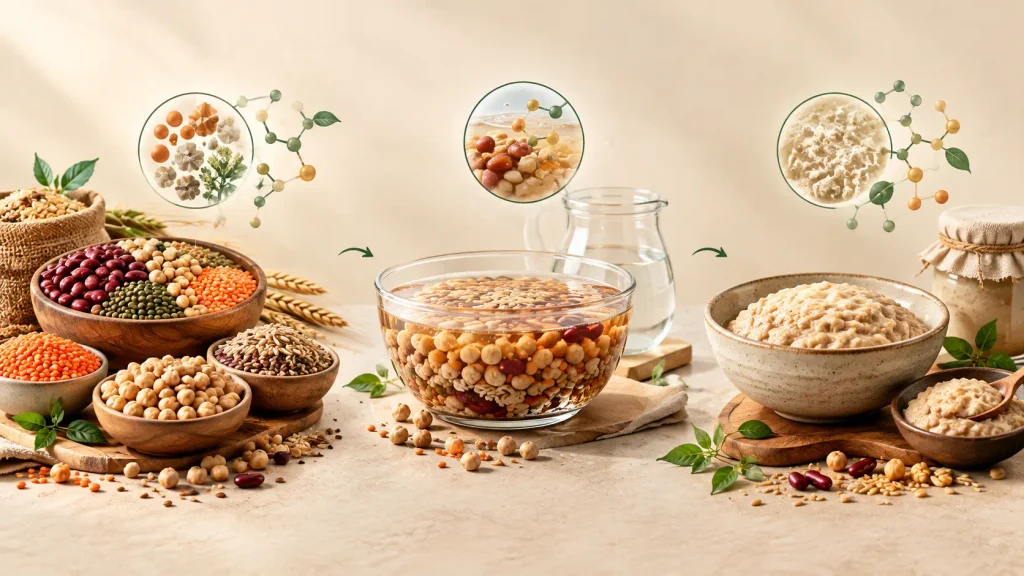
Phytate, also called phytic acid in some contexts, is a phosphorus-containing compound naturally found in many plant foods.
It is particularly relevant to grains, legumes and seeds.
The problem for iron absorption is that phytate can interact with minerals and form complexes that are less available for absorption.
The NIH Office of Dietary Supplements specifically identifies phytate present in grains and beans as a factor that can inhibit non-heme iron absorption.
Research on legumes also shows that phytate is an important contributor to their relatively low mineral bioavailability, although other components of the food matrix matter too.
Phytate
can bind and reduce availability of
Non-heme iron
Phytate can bind minerals, so less iron may remain available for absorption. But processing can change this.
This gives us a simplified pathway:
- Grain or bean
- Contains non-heme iron + phytate
- Phytate can bind minerals
- Less iron may remain available for absorption
But processing can change this.
What happens when you soak grains and beans?
Soaking exposes the food to water and changes its physical and chemical environment.
Under appropriate conditions, soaking can activate phytase, an enzyme capable of breaking down phytate.
This can lower the amount of phytate remaining in the food.
Older research examining food processing found that soaking, germination and fermentation could substantially reduce phytate under favorable processing conditions.
Research on legumes has similarly identified soaking as one of several food-processing approaches capable of increasing the activity of naturally occurring enzymes involved in phytate degradation.
But there is a catch.
Soaking does not simply remove phytate while leaving everything else unchanged. Water-soluble minerals and other compounds can also move into the soaking water.
That means the nutritional effect of soaking depends on:
- the type of grain or bean
- soaking duration
- temperature
- water-to-food ratio
- whether the soaking water is discarded
- subsequent cooking
- phytase activity
- the food’s original phytate content
So “soaked” is not a single standardized nutritional treatment.
Does soaking actually increase iron absorption?
This is where the evidence becomes more complicated.
Soaking can reduce phytate, but a reduction in phytate is not itself a measurement of iron absorption.
Some studies have found improved iron availability after soaking. For example, research on faba beans found that soaking reduced phytate and improved measured in-vitro iron availability. However, the treatment also caused losses of iron from the food.
That distinction matters.
Imagine that soaking produces less phytate, but also less total iron remaining in the food. The final effect on the amount of iron absorbed from the serving cannot be predicted simply from the phytate measurement.
Another study examining common household processing of beans found that soaking reduced total phytate, but did not produce significant differences in iron retention under the tested conditions.
So the evidence does not support a universal statement such as:
“Soaking beans always increases iron absorption.”
A more accurate statement is:
Soaking can reduce phytate and may improve iron bioavailability, but the effect varies with the food and processing method, and mineral losses can also occur.
What happens during fermentation?
Fermentation adds another layer to the process.
Microorganisms grow and metabolize components of the food, changing its:
- acidity
- enzyme activity
- phytate content
- organic acid composition
- food structure
- mineral environment
One important consequence can be greater phytate degradation.
A review of mineral bioavailability in legumes identified fermentation, soaking and germination as food-processing strategies that can promote phytate degradation.
But fermentation is not simply “soaking for longer.” The microorganisms involved can change the food in ways that ordinary soaking cannot.
Lactic fermentation, for example, can lower pH and increase acidity while microbial enzymes and food enzymes contribute to phytate breakdown. This can change the chemical environment around iron.
Why might fermentation have a stronger effect?
The key is that fermentation can combine several mechanisms.
- Phytate degradation — microbial and plant phytases can break down phytate.
- Increased acidity — fermentation often lowers pH, which can influence mineral solubility.
- Changes in the food matrix — fermentation can alter proteins, carbohydrates and other components surrounding the mineral.
- Changes in other inhibitors — depending on the food and microorganisms, fermentation can also influence compounds such as tannins and polyphenols.
This is why the effect cannot be reduced to one molecule.
A study examining fermented bean flour found that natural and controlled fermentation reduced phytate by about 36%. Iron dialyzability improved significantly after natural fermentation, although controlled fermentation did not produce the same iron effect.
That finding illustrates an important principle: fermentation method matters.
Soaking vs. fermentation
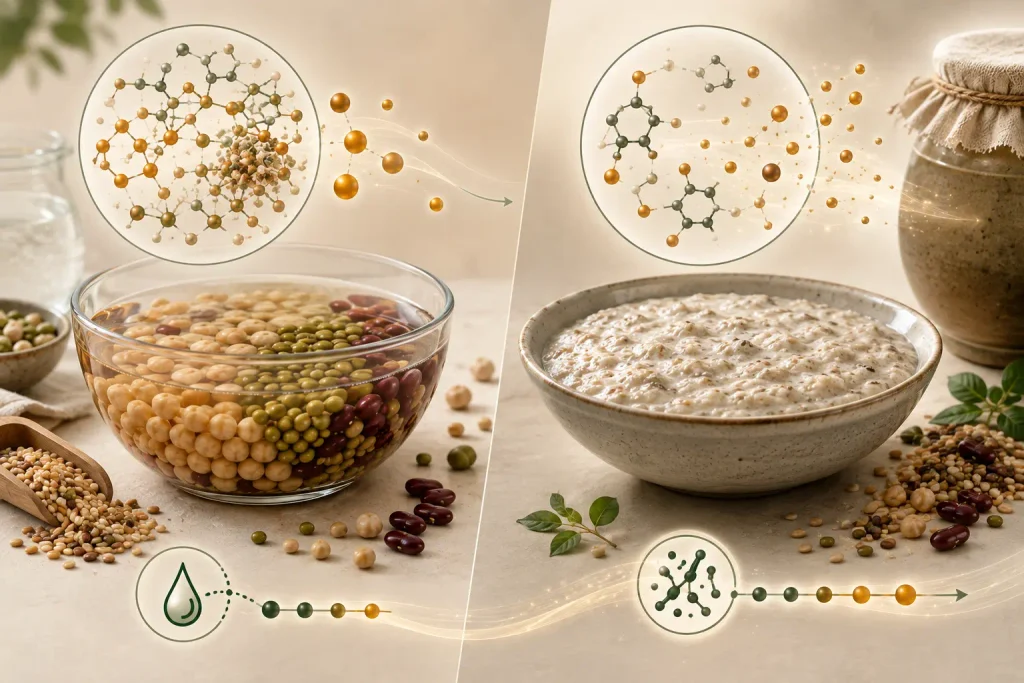
| Soaking | Fermentation | |
|---|---|---|
| Main process | Water exposure | Microbial transformation |
| Can reduce phytate? | Yes, under suitable conditions | Yes |
| Can change mineral availability? | Yes | Yes |
| Effect on iron | Variable | Often promising |
| Main limitation | May also cause nutrient losses | Results depend strongly on microorganisms and conditions |
| Human evidence | Limited and inconsistent for direct absorption effects | More evidence for absorption and bioavailability, but long-term status remains uncertain |
| Best interpretation | May improve the food’s mineral environment | Can substantially alter the food’s mineral bioavailability |
The important point is that neither process guarantees a specific increase in absorbed iron.
What about idli, dosa and other fermented foods?
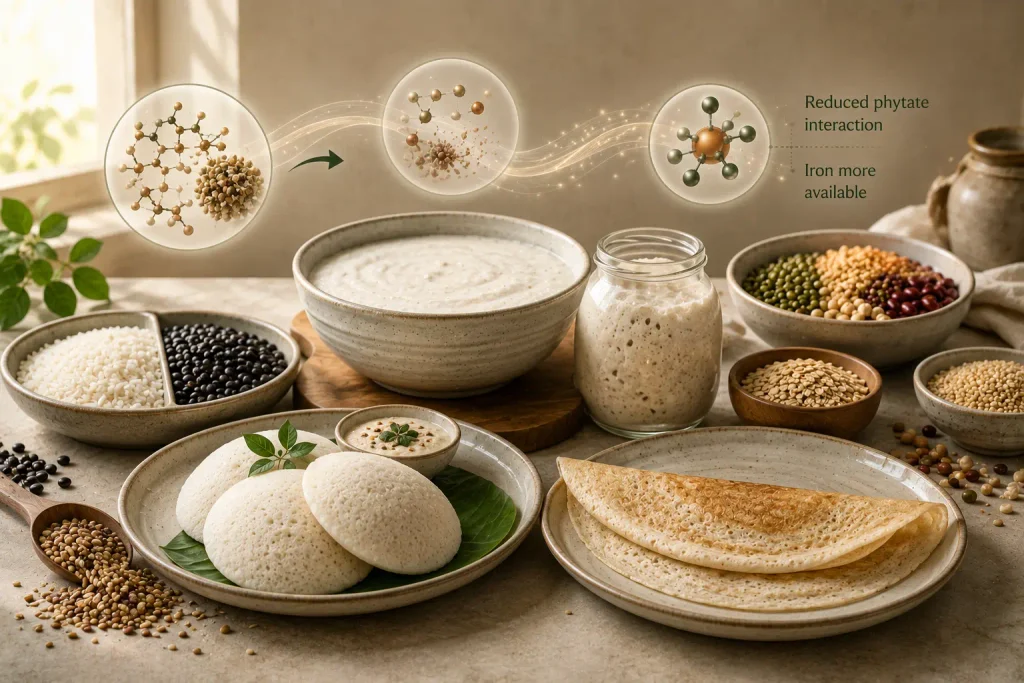
This is where the science becomes particularly interesting.
Traditional foods can provide natural examples of how food processing changes nutrient bioavailability.
A study examining cereal-pulse combinations used in foods such as idli, dosa and dhokla found that fermentation substantially increased measured iron bioaccessibility in the idli and dosa preparations.
In the tested rice–black gram batters, iron bioaccessibility increased by approximately 277% for one idli formulation and 127% for one dosa formulation. However, the effect was not observed in the dhokla formulation containing a different combination of legumes and cereal.
That last detail is just as important as the large numbers. The same general processing category did not produce the same result in every food.
The researchers linked the improvements partly to reductions in phytate and tannins.
This is exactly why NutriFoodGuide avoids saying:
“Fermentation increases iron absorption.”
The more scientifically defensible statement is:
Certain fermentation processes can increase iron bioaccessibility or absorption, but the magnitude depends on the food and fermentation conditions.
Does fermentation increase the iron content of food?
Not necessarily. This is another important distinction.
Fermentation can potentially make existing iron more available without increasing the total amount of iron originally present.
| Iron content | How much iron is present. |
|---|---|
| Iron bioavailability | How much of that iron is potentially available for absorption. |
| Iron absorption | How much actually enters the body. |
Fermentation primarily changes the second category, although processing can also cause gains or losses in the first category.
Therefore: more bioavailable iron does not necessarily mean more total iron.
What does the human evidence show?
There are several layers of evidence.
Controlled absorption studies
Some human studies directly measure iron absorption and provide stronger evidence than laboratory measurements alone.
Research on fermented bread has shown that reducing phytate can improve aspects of iron bioavailability and, in some studies, iron absorption. Earlier controlled human research also found that prolonged fermentation of whole-rye bread could increase fractional iron absorption to levels similar to low-phytate control bread.
Another human study found that enzymatic degradation of phytate substantially increased iron absorption from cereal porridges made from rice, oats, maize, wheat and wheat-soy blends.
These studies provide evidence that phytate reduction can matter for actual iron absorption.
In-vitro and cell studies
Other studies measure iron bioaccessibility or uptake using simulated digestion or cultured cells. These studies are useful for understanding mechanisms but cannot be treated as equivalent to measuring iron absorption in people.
For example, recent research has found that fermentation can substantially reduce phytate and increase indicators of mineral availability in legume-based foods, but some of this evidence comes from in-vitro or cell-based models.
Long-term human outcomes
This is where the evidence becomes much less certain.
A 2026 systematic review identified eight human intervention studies examining sourdough or regular-bread fermentation and iron bioavailability, absorption or status. The review found that acute studies often showed improved non-heme iron bioavailability, particularly with low-phytate products.
But longer-term studies did not consistently improve ferritin or total body iron. The authors concluded that while the mechanism is convincing, the available human evidence is insufficient to establish that sourdough fermentation itself reliably improves long-term iron status.
That distinction is crucial.
What the evidence does not show
The evidence does not establish that:
- soaking every grain or bean substantially increases iron absorption
- fermentation always increases iron absorption
- fermented foods prevent iron deficiency
- soaking or fermentation makes plant-based iron equivalent to heme iron
- reducing phytate automatically improves long-term iron status
- every fermented food has the same nutritional effect
- longer fermentation is always better
The evidence is much stronger for this narrower claim:
Reducing phytate can improve the bioavailability of non-heme iron under appropriate conditions.
Whether a particular traditional or industrial food-processing method achieves that effect depends on the food and the process.
Does everyone benefit in the same way?
Probably not.
Iron absorption is influenced by the broader meal and by the body’s iron requirements.
The NIH notes that non-heme iron absorption is affected by dietary enhancers such as vitamin C and inhibitors such as phytate and certain polyphenols. You can read more about how vitamin C enhances non-heme iron absorption and how tea affects non-heme iron absorption.
That means the same fermented bean dish can have a different absorption environment depending on what accompanies it.
For example, fermented grain with vitamin-C-rich vegetables creates a different nutritional environment from unprocessed grain with high-phytate ingredients and tea.
The food-processing step is only one part of the interaction.
Does cooking matter too?
Yes, but cooking and fermentation should not be treated as interchangeable.
Cooking can:
- soften plant tissues
- change the food matrix
- reduce some antinutritional compounds
- improve digestibility
- cause some nutrients to leach into cooking water
For beans, soaking followed by cooking can reduce phytate, but processing can also affect mineral retention.
Research on common bean preparation found substantial retention of iron after boiling, while soaking changed phytate levels without producing a consistent difference in iron retention.
This reinforces the broader principle: food preparation changes both the nutrient and its surrounding matrix. The final nutritional effect depends on the balance.
Context matters
The question “Does soaking improve iron absorption?” sounds simple. The science isn’t.
Consider four different situations.
Whole grains
Their phytate content can influence non-heme iron bioavailability.
Beans
Soaking may reduce phytate, but some minerals can also be lost into the soaking water.
Fermented cereal-legume foods
Fermentation can substantially alter phytate, acidity and the food matrix, potentially improving iron bioaccessibility.
A complete meal
Vitamin C, tea, coffee, calcium, other polyphenols and the individual’s iron status can all change the absorption environment.
This is why food preparation should be viewed as part of a larger meal-context system.
Practical takeaway
So, should you soak or ferment your grains and beans because you want to absorb more iron? The evidence supports a nuanced answer.
Soaking and fermentation can change the bioavailability of iron in grains and beans, largely by altering compounds such as phytate. Fermentation can be particularly effective at reducing phytate and has produced increases in iron bioaccessibility or absorption in several experimental settings.
But the effect is not universal. It depends on the food, the amount of phytate, soaking conditions, fermentation method, microorganisms involved, duration, acidity, cooking, mineral losses, and the rest of the meal.
For most readers, the main lesson is not that every bean must be fermented or every grain must be soaked. It is this: food preparation can change nutrient bioavailability.
And when it comes to plant-based iron, processing methods that reduce phytate may make some of that iron more available for absorption. But better bioavailability from a food does not automatically translate into better long-term iron status. That is where the evidence still needs to be interpreted carefully.
Frequently asked questions
Does soaking beans increase iron absorption?
Soaking can reduce phytate and may improve iron bioavailability, but the effect varies by bean and processing method. Some soaking studies also show mineral losses, so reduced phytate does not automatically mean more iron will be absorbed.
Does fermenting beans increase iron absorption?
Fermentation can improve iron bioavailability by reducing phytate and altering the food’s chemical environment. However, the effect depends on the fermentation process and food. Some studies show improved iron availability while others show smaller or no effects.
Why does fermentation affect iron?
Fermentation can reduce phytate through enzymatic activity, increase acidity and alter the food matrix. These changes can make non-heme iron more available for absorption.
Is soaking better than fermentation for iron?
There is no universal winner. Fermentation can produce greater phytate reduction under suitable conditions, but the nutritional effect depends on the food and process.
Does soaking remove iron from beans?
Soaking can cause some minerals to move into the soaking water. Research therefore shows that soaking can reduce phytate while also affecting mineral retention.
Does fermentation increase the amount of iron in food?
Not necessarily. Fermentation can improve the availability of existing iron without increasing the total iron content.
Does cooking reduce phytate?
Cooking can contribute to changes in phytate and other food compounds, especially when combined with soaking or fermentation, but the magnitude depends on the food and cooking method.
Are fermented foods automatically better sources of iron?
No. Fermentation can improve iron bioavailability in some foods, but it does not automatically make every fermented food a high-iron or highly bioavailable source.
Does vitamin C still matter if beans are soaked or fermented?
Yes. Processing is only one part of the absorption equation. Vitamin C can enhance non-heme iron absorption, while other meal components can inhibit it.
Does this mean plant-based iron is poorly absorbed?
Plant-based foods provide non-heme iron, whose absorption is more sensitive to meal composition than heme iron. But absorption is not fixed. Food preparation and meal composition can influence its bioavailability.
Sources
- National Institutes of Health, Office of Dietary Supplements. Iron — Fact Sheet for Health Professionals. ods.od.nih.gov
- Sandberg AS, Svanberg U. The effect of food processing on phytate hydrolysis and availability of iron and zinc. PMID 1654732
- Sandberg AS. Bioavailability of minerals in legumes. Br J Nutr. PMID 12498628
- Hurrell RF, Reddy MB, Burri J, Cook JD. Phytate degradation determines the effect of industrial processing and home cooking on iron absorption from cereal-based foods. Br J Nutr. PMID 12144715
- Brune M, Rossander-Hultén L, Hallberg L, Gleerup A, Sandberg AS. Iron absorption from bread in humans: inhibiting effects of cereal fiber, phytate and inositol phosphates with different numbers of phosphate groups. J Nutr. 1992;122(3):442–449. doi:10.1093/jn/122.3.442
- Hurrell RF, Reddy MB, Juillerat MA, Cook JD. Degradation of phytic acid in cereal porridges improves iron absorption by human subjects. Am J Clin Nutr. PMID 12716674
- Hemalatha S, Platel K, Srinivasan K. Influence of germination and fermentation on bioaccessibility of zinc and iron from food grains. Eur J Clin Nutr. 2007;61(3):342–348. doi:10.1038/sj.ejcn.1602524
- Paredes-López O, et al. Effect of natural and controlled fermentation on chemical composition and nutrient dialyzability from beans. PMID 12903982
- Ribeiro ND, et al. Effect of traditional household processes on iron, zinc and copper bioaccessibility in black bean. PMID 30065167
- Effects of sourdough- or regular-bread fermentation, and phytate reduction on iron bioavailability, absorption, and iron status in humans: a systematic review of intervention studies. Front Nutr. 2026. doi:10.3389/fnut.2026.1778997
Subjects covered in this chapter
Continue exploring
Related interactions
Phytate + Zinc: How Does Phytic Acid Affect Zinc Absorption?
Food + Nutrient
You can eat a food that contains zinc and still absorb less of it than you might expect. One reason is phytate.…
Does Your Morning Tea Affect Your Iron Intake?
Absorption & Bioavailability
If your morning routine includes a cup of tea with breakfast, you may have wondered whether that habit affects your iron. The…
Does vitamin C affect the absorption of iron?
Absorption & Bioavailability
Pair your lentils with a squeeze of lemon. Drink orange juice with your fortified cereal. It is one of the most repeated…