

If your morning routine includes a cup of tea with breakfast, you may have wondered whether that habit affects your iron.
The important distinction is this:
Tea does not necessarily reduce the amount of iron you consume. It can, however, reduce the amount of certain dietary iron that your body absorbs when the tea is consumed with an iron-containing meal.
This effect is particularly relevant to non-heme iron, the form found in plant foods and iron-fortified foods. Tea contains polyphenolic compounds that can interfere with the absorption of non-heme iron. Human studies using stable iron isotopes have demonstrated this effect under controlled conditions.
That does not mean that drinking tea automatically causes iron deficiency or that everyone needs to stop drinking tea. The effect depends on the meal, the form of iron, the amount and type of tea, and the person’s overall iron status and dietary pattern.
So the better question is not “Does tea reduce iron?”
It is:
“How does drinking tea around an iron-containing meal affect iron absorption?”
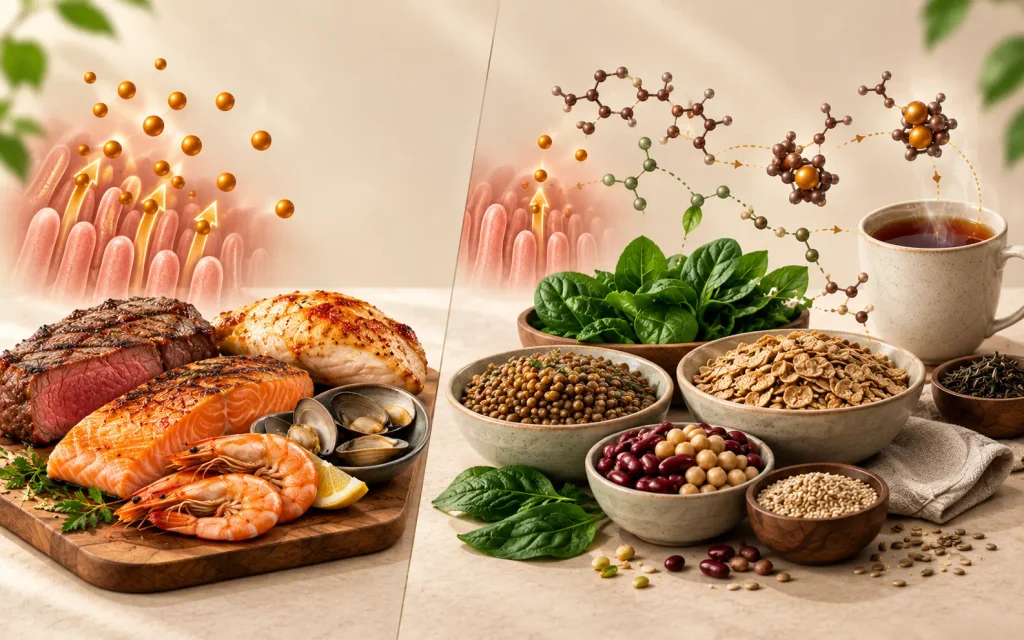
Quick answer
Yes, morning tea can affect iron absorption if you drink it with an iron-containing meal, particularly when the meal provides mostly non-heme iron.
Tea contains polyphenols that can bind or interact with iron in the digestive tract, making some non-heme iron less available for absorption. Controlled human studies have found substantially lower iron absorption when tea is consumed with meals.
However, this is an absorption effect, not a reduction in the iron content of the food.
A person’s overall iron status, dietary pattern, sources of iron, meal composition and frequency of tea consumption all matter. The NIH Office of Dietary Supplements notes that inhibitors and enhancers of iron absorption can have less impact within a typical mixed diet than they may appear to have in controlled test-meal experiments.
Interaction at a glance
| Subject A | Iron |
|---|---|
| Subject B | Tea |
| Relationship | Tea polyphenols can inhibit absorption of non-heme iron |
| Main context | Tea consumed with or close to an iron-containing meal |
| Most affected form | Non-heme iron |
| Potential mechanism | Tea polyphenols interact with iron during digestion and reduce its bioavailability |
| Evidence | Supported by controlled human absorption studies |
| Important nuance | Reduced absorption from a meal does not automatically mean reduced body iron status |
| Timing | Separating tea from an iron-containing meal can reduce the inhibitory effect |
| Big distinction | Iron intake ≠ iron absorption ≠ iron status |
What are iron and tea?
What is iron?
Iron is an essential mineral involved in several biological processes. It is a component of hemoglobin, the protein in red blood cells that carries oxygen, and it is also involved in myoglobin, cellular function and other physiological processes.
Dietary iron occurs in two main forms:
- Heme iron, found in meat, seafood and poultry.
- Non-heme iron, found in plant foods and iron-fortified foods.
Heme iron generally has higher bioavailability, while non-heme iron is more strongly influenced by other components of the meal. Vitamin C and some animal foods can enhance non-heme iron absorption, while phytate and certain polyphenols can reduce it.
What is tea?
Tea made from Camellia sinensis includes beverages such as black, green and oolong tea. These teas contain various polyphenolic compounds.
The composition depends on the tea type, processing, brewing conditions and serving. For example, NIH notes that catechin concentrations can vary substantially between tea samples and with brewing time.
For iron absorption, the important point is not simply that tea is “healthy” or “unhealthy.”
It is that tea contains compounds capable of interacting with dietary iron.
How can tea affect iron absorption?
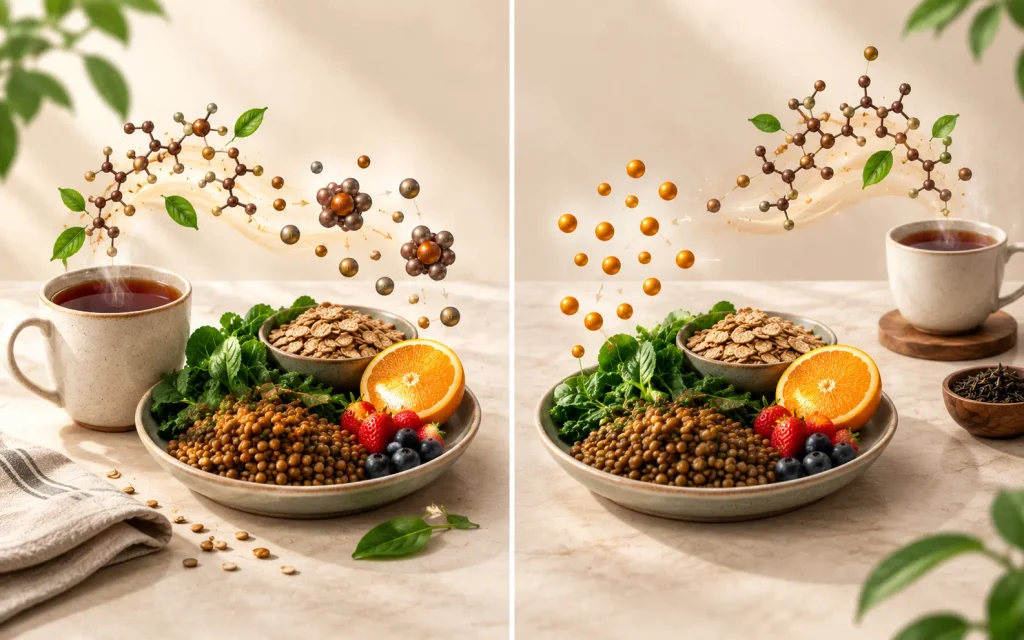
The interaction occurs primarily during digestion.
When you eat an iron-containing meal, the iron must remain sufficiently available in the digestive tract for absorption. Non-heme iron is particularly sensitive to the chemical environment created by the rest of the meal.
Tea polyphenols can interact with iron and reduce its availability for absorption.
Human experiments have demonstrated this relationship directly.
An early controlled study found that polyphenol-containing beverages, including black tea, reduced non-heme iron absorption from a bread-based meal. The degree of inhibition varied according to the beverage and its polyphenol content.
Tea polyphenols
reduce absorption of
Non-heme iron
This is a bioavailability relationship. It does not mean that the iron has disappeared from the food.
The relationship is therefore better represented as:
- Tea containing polyphenols
- Interaction with dietary non-heme iron
- Less iron remains available for absorption
- Lower fractional absorption from that meal
Why is non-heme iron the main concern?
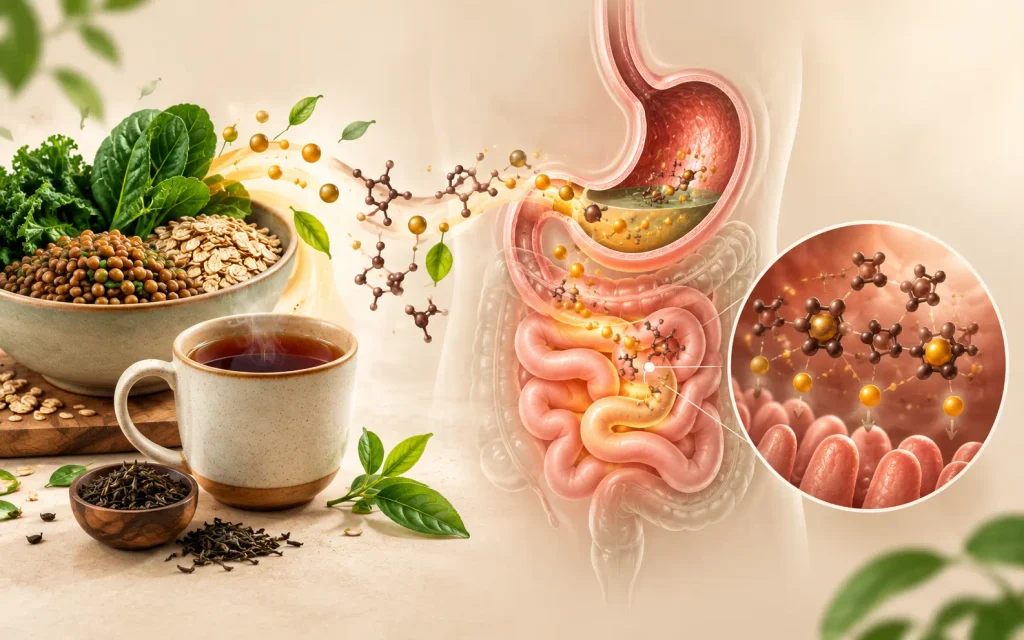
The distinction between heme and non-heme iron is central to understanding the tea–iron relationship. If you are new to it, this explainer on the difference between heme and non-heme iron covers why the form matters more than the number on a label.
Non-heme iron is found in foods such as:
- beans
- lentils
- spinach
- nuts
- vegetables
- grains
- iron-fortified cereals and breads
Heme iron is found in meat, seafood and poultry.
Non-heme iron is more sensitive to dietary enhancers and inhibitors.
That is why the same cup of tea does not necessarily have the same nutritional significance in every meal.
For example, a breakfast based heavily on fortified cereal or plant foods may contain a substantial proportion of its iron as non-heme iron. A meal containing more heme iron is less dependent on non-heme iron absorption.
This is one reason why meal composition matters.
Does drinking tea with breakfast matter?
Yes, particularly when breakfast itself is an important source of non-heme iron.
Controlled human studies have repeatedly demonstrated that tea consumed alongside an iron-containing meal can reduce non-heme iron absorption.
In one study of young Indian women, one or two cups of black tea consumed with a rice-based test meal reduced iron absorption by approximately 49% and 66%, respectively, in iron-replete participants. Similar reductions were observed in women with iron-deficiency anemia.
Another controlled trial examined tea consumed simultaneously with an iron-containing porridge meal. Iron absorption was lower when tea was consumed with the meal than when water was consumed with it.
These studies are useful because they directly measured iron absorption, rather than simply estimating it from dietary intake.
But there is an important limitation:
A reduction in absorption from one meal does not automatically tell us how much a person’s long-term iron status will change.
That depends on the entire dietary pattern and the body’s regulation of iron absorption.
Does waiting after breakfast help?
Research suggests that separating tea from an iron-containing meal can reduce the inhibitory effect.
A controlled study in healthy women compared three conditions:
- an iron-containing meal with water
- the same meal with tea at the same time
- the meal followed by tea one hour later
Tea consumed simultaneously with the meal reduced iron absorption. When tea was consumed one hour after the meal, the inhibitory effect was substantially smaller. The researchers estimated that the reduction in tea’s inhibitory effect was about half when the tea was delayed by one hour.
This provides an important practical insight:
The interaction depends not only on what you consume, but also on when you consume it relative to the meal.
However, this does not justify creating a universal rule that everyone must wait a particular number of hours after every meal.
The study specifically tested a one-hour interval under controlled conditions. Real-world meals are much more complicated.
Does the type of tea matter?
Probably.
Tea is not a chemically identical beverage across all varieties.
Polyphenol composition can differ according to:
- tea species and variety
- processing
- brewing time
- serving size
- concentration
Studies have found differences in the degree to which various polyphenol-containing beverages inhibit iron absorption. In one human study, black tea produced a particularly strong inhibitory effect compared with several other tested beverages at comparable polyphenol concentrations.
Green tea can also inhibit non-heme iron absorption. In a controlled study, adding a green-tea phenolic extract to a meal reduced measured non-heme iron absorption.
So the scientifically accurate message is not:
“All tea affects iron in exactly the same way.”
It is:
Tea beverages contain polyphenolic compounds that can inhibit non-heme iron absorption, but the magnitude of the effect varies with the beverage and the meal.
What about tea with milk?
Adding milk does not necessarily eliminate tea’s effect on iron absorption.
In an earlier controlled study examining polyphenol-containing beverages, adding milk to tea or coffee had little or no influence on their inhibitory effect on iron absorption. The same study is the basis for what we know about how coffee can affect iron absorption.
This is another reason to be cautious about simple nutrition rules.
The interaction cannot reliably be reduced to:
“Tea is fine for iron if you add milk.”
The evidence does not support that as a general solution.
What other factors influence the interaction?
Tea is only one part of the meal.
Vitamin C can work in the opposite direction
Vitamin C is an important enhancer of non-heme iron absorption — the mirror image of what tea does, and worth reading alongside this article: how vitamin C affects non-heme iron absorption.
The NIH Office of Dietary Supplements notes that ascorbic acid can enhance non-heme iron bioavailability. Foods such as citrus fruits, strawberries, sweet peppers, tomatoes and broccoli provide vitamin C.
This means that a meal containing non-heme iron and vitamin C has a different absorption environment from a meal containing non-heme iron and tea.
For example:
Lentils + vegetables rich in vitamin C may create a different absorption context from Lentils + tea.
The overall meal matters.
Phytate can also influence non-heme iron
Phytate is found in foods such as grains and legumes and can inhibit non-heme iron absorption. Preparation methods change how much is present, which is covered in how phytate affects iron bioavailability.
This means a plant-based meal can contain several factors affecting iron absorption simultaneously.
That is why it is misleading to think about tea in isolation.
Iron status matters
The body also regulates iron absorption according to its iron needs.
The NIH identifies hepcidin as a key regulator of iron absorption and iron distribution. Iron absorption can therefore differ considerably between people with different iron status.
In one study of Indian women, iron absorption was substantially higher among women with iron-deficiency anemia than among iron-replete women, even though tea reduced absorption in both groups.
What does the evidence show?
The evidence for the short-term effect of tea on non-heme iron absorption is relatively clear.
Controlled human studies have repeatedly found that tea consumed with iron-containing meals can reduce measured non-heme iron absorption.
There is also evidence that the effect can occur with different forms of dietary or fortified iron.
For example, a study in Moroccan women found that green tea reduced iron absorption from meals fortified with NaFeEDTA by more than 85% under the experimental conditions, both in women with iron-deficiency anemia and in nonanemic women.
However, these large percentages should not be interpreted as meaning that drinking tea causes an equivalent reduction in a person’s daily iron status.
The experiments measured fractional absorption from specific test meals.
That is a very different question from:
“Does drinking tea every morning cause iron deficiency?”
The available evidence does not support making that leap.
A systematic review of iron absorption from whole diets found substantial variation between studies and highlighted the importance of iron status and dietary enhancers and inhibitors. The review also noted that evidence for the effect of individual inhibitors in whole diets was less straightforward than evidence from controlled test meals.
The NIH similarly notes that the effects of dietary enhancers and inhibitors can be attenuated in typical mixed diets and may therefore have relatively little effect on iron status for most people.
What the evidence does not show
This distinction is essential.
The evidence shows
Tea can reduce non-heme iron absorption from an iron-containing meal.
The evidence does not automatically show
Drinking tea causes iron deficiency in everyone who drinks it.
Those are two different claims.
A controlled absorption study answers a question about how much iron enters the body from a particular test meal.
Iron status is influenced by many other factors, including:
- total dietary iron intake
- the proportion of heme and non-heme iron
- overall dietary pattern
- iron stores
- physiological iron requirements
- blood loss
- absorption conditions
- other dietary enhancers and inhibitors
The NIH notes that iron deficiency is more common in certain groups, including menstruating women, pregnant people, young children and people with conditions that affect nutrient absorption.
Therefore, the importance of the tea interaction depends heavily on context.
Context matters
Imagine two people who both drink tea every morning.
Person A
Breakfast contains:
- an iron-fortified cereal
- fruit
- a vitamin-C-rich food
- tea
Tea may reduce absorption of some of the non-heme iron in the meal, but the overall meal contains an enhancer of non-heme iron absorption as well.
Person B
Breakfast contains:
- mostly plant-based iron sources
- tea consumed alongside the meal
- few sources of vitamin C
The tea–iron interaction may be more relevant to the meal’s overall iron bioavailability.
These examples illustrate why there is no single answer that applies equally to every tea drinker.
The question is not simply:
“Do you drink tea?”
It is:
“How important is that meal as a source of absorbable iron, and what else is being eaten with it?”
Does morning tea affect your iron intake or absorption?
This is where terminology matters.
| Iron intake | The amount of iron you consume in food or beverages. |
|---|---|
| Iron absorption | The amount of that dietary iron that crosses from the digestive tract into the body. |
| Iron status | The body’s overall iron stores and availability, assessed using measures such as ferritin and other laboratory indicators. |
These are related, but they are not interchangeable.
If tea reduces absorption from a breakfast meal, it does not mean the meal suddenly contains less iron.
The iron content remains in the food.
What changes is the fraction that may become available for absorption.
This distinction is one of the most important ideas in understanding food–nutrient interactions.
Practical takeaway
If you enjoy morning tea, there is no need to turn the subject into an all-or-nothing nutrition rule.
The evidence supports a more precise conclusion: tea consumed with an iron-containing meal can reduce absorption of non-heme iron, largely because of tea’s polyphenolic compounds.
If a particular meal is an important source of non-heme iron, separating tea from that meal may reduce the inhibitory effect. A controlled human study found that moving tea to one hour after an iron-containing meal substantially attenuated the effect.
For most readers, the important distinction is therefore not “Tea is bad for iron.” It is: “Tea can influence the bioavailability of non-heme iron, especially when consumed with the meal.”
The significance of that interaction depends on the rest of the diet and the person’s iron status.
Frequently asked questions
Does tea reduce iron absorption?
Yes. Human studies show that tea can reduce absorption of non-heme iron when consumed with an iron-containing meal. Tea polyphenols are thought to play an important role in this interaction.
Should I stop drinking tea if I want enough iron?
Not necessarily. The evidence shows an absorption effect, not that tea automatically causes iron deficiency. Overall diet, iron status and meal composition all matter.
Is tea worse for plant-based iron?
Tea’s inhibitory effect is particularly relevant to non-heme iron, which is the form found in plant foods and fortified foods. Heme iron is generally more bioavailable and less affected by dietary factors.
Can I drink tea after an iron-rich meal?
Research suggests that separating tea from an iron-containing meal can reduce its inhibitory effect. One controlled trial found that consuming tea one hour after a meal produced substantially less inhibition than drinking it with the meal.
Does adding milk to tea prevent the effect on iron?
Evidence from a controlled study found that adding milk to tea had little or no effect on the beverage’s inhibitory influence on iron absorption.
Does green tea also affect iron absorption?
Yes. Controlled research has found that green-tea polyphenols can reduce non-heme iron absorption.
Does tea affect heme iron?
The tea–iron interaction is primarily important for non-heme iron. Heme iron is generally less sensitive to dietary factors that affect non-heme iron bioavailability.
Does drinking tea cause iron deficiency?
The evidence does not establish that drinking tea causes iron deficiency in everyone. Tea can reduce iron absorption from individual meals, but long-term iron status depends on many factors.
Is tea with breakfast a problem for everyone?
No. Its importance depends on the meal, the type and amount of iron, other foods consumed, the frequency of tea consumption and the individual’s iron status.
Sources
- National Institutes of Health, Office of Dietary Supplements. Iron — Fact Sheet for Health Professionals. ods.od.nih.gov
- National Institutes of Health, Office of Dietary Supplements. Iron — Fact Sheet for Consumers. ods.od.nih.gov
- Ahmad Fuzi SF, Koller D, Bruggraber S, Pereira DIA, Dainty JR, Mushtaq S. A 1-h time interval between a meal containing iron and consumption of tea attenuates the inhibitory effects on iron absorption: a controlled trial in a cohort of healthy UK women using a stable iron isotope. Am J Clin Nutr. 2017;106(6):1413–1421. PMID 29046302
- Hurrell RF, Reddy M, Cook JD. Inhibition of non-haem iron absorption in man by polyphenolic-containing beverages. Br J Nutr. 1999;81(4):289–295. PMID 10999016
- Thankachan P, Walczyk T, Muthayya S, Kurpad AV, Hurrell RF. Iron absorption in young Indian women: the interaction of iron status with the influence of tea and ascorbic acid. Am J Clin Nutr. 2008;87(4):881–886. PMID 18400710
- Lazrak M, El Kari K, Stoffel NU, et al. Tea consumption reduces iron bioavailability from NaFeEDTA in nonanemic women and women with iron deficiency anemia: stable iron isotope studies in Morocco. J Nutr. 2021;151(9):2714–2720. PMID 34038558
- Collings R, Harvey LJ, Hooper L, et al. The absorption of iron from whole diets: a systematic review. Am J Clin Nutr. 2013;98(1):65–81. PMID 23719560
- Samman S, Sandström B, Toft MB, et al. Green tea or rosemary extract added to foods reduces nonheme-iron absorption. Am J Clin Nutr. 2001;73(3):607–612. PMID 11237939
Subjects covered in this chapter
Continue exploring
Related interactions
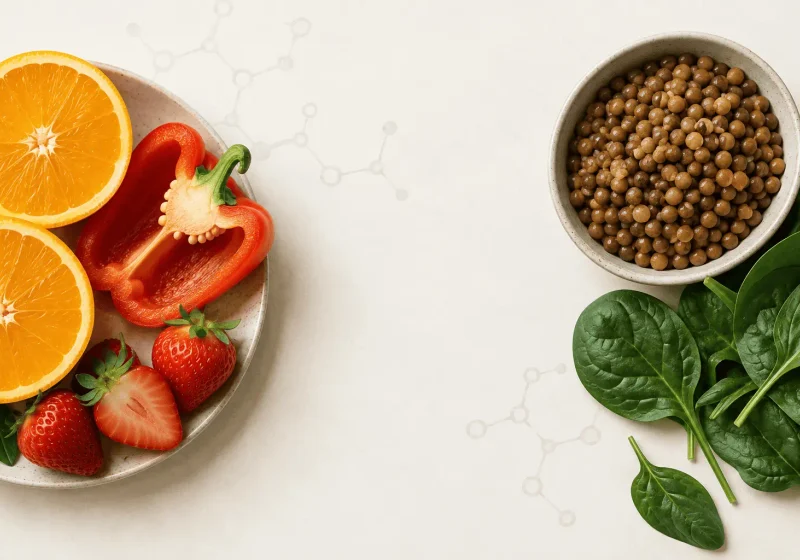
Does vitamin C affect the absorption of iron?
Absorption & Bioavailability
Pair your lentils with a squeeze of lemon. Drink orange juice with your fortified cereal. It is one of the most repeated…
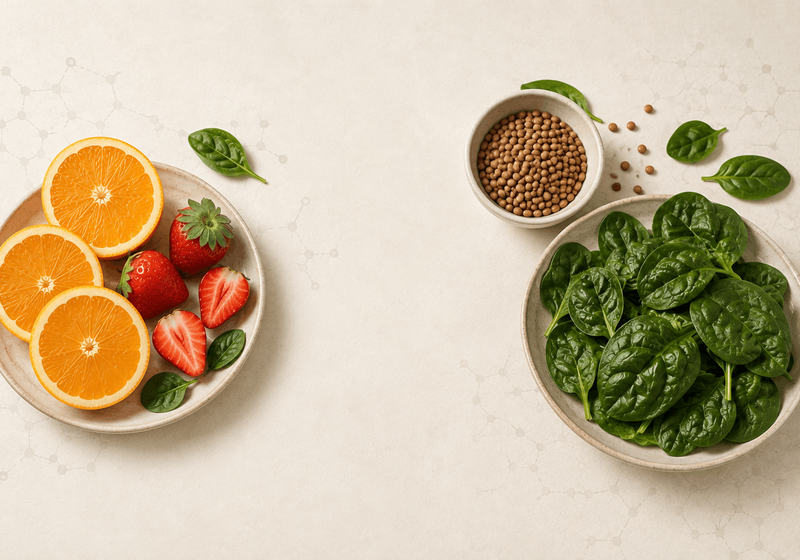
How to Improve Iron Absorption from Plant Foods
Absorption & Bioavailability
What actually changes how much iron you absorb from a plant-based meal, and what to do about it at the table.
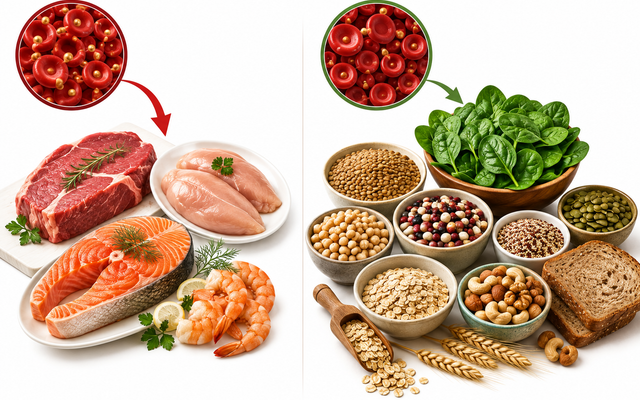
Does soaking or fermenting grains and beans change how much iron you absorb?
Preparation & Meal Context
Quick answer In a single meal, yes — calcium reduces the absorption of both heme and non-heme iron, and it is the…