

You can eat a food that contains zinc and still absorb less of it than you might expect.
One reason is phytate.
Phytate, often called phytic acid, is naturally present in many plant foods, particularly whole grains, legumes, nuts, and seeds. These foods can also be important sources of zinc.
That creates an interesting nutritional interaction:
- Plant food
- Zinc + phytate
- Interaction during digestion
- Potentially less zinc available for absorption
The effect is real, but it isn’t as simple as saying that phytate “blocks all zinc.”
The amount of phytate, the amount of zinc, food preparation, the rest of the meal, and the body’s ability to adapt to dietary zinc can all influence the outcome.
So what does the research actually show?
Quick answer
Yes. Phytate can reduce zinc absorption.
Phytate can bind zinc in the digestive tract and form complexes that are less available for absorption. The NIH Office of Dietary Supplements identifies phytates in beans, nuts, and whole grains as an important reason why zinc from many plant foods has lower bioavailability than zinc from animal foods.
Human studies provide direct evidence. In a controlled stable-isotope study, adding phytate to test meals substantially reduced zinc absorption. Another human study found that removing most of the phytate from a cereal-based food increased fractional zinc absorption from about 22.8% to 34.6%.
But this does not mean that eating beans, whole grains, nuts, or seeds automatically causes zinc deficiency.
The effect depends on the overall diet and the relationship between zinc intake and phytate intake. And food preparation can change that relationship.
First: what is zinc?
Zinc is an essential mineral involved in many biological processes.
It supports:
- immune function
- DNA and protein synthesis
- wound healing
- cell signaling
- growth and development
- normal taste and smell
Zinc is found in both animal and plant foods.
Good dietary sources include meat, seafood, eggs, and dairy products. Plant foods such as beans, nuts, and whole grains also provide zinc.
The important difference isn’t simply how much zinc is present. It is also how much of that zinc is available for absorption.
Zinc content is not the same as zinc absorption
Imagine two foods.
Food A contains zinc, but also contains a substantial amount of phytate. Food B contains a similar amount of zinc but has less phytate.
The body does not necessarily absorb the same proportion of zinc from both foods.
This is why nutrition researchers distinguish between:
| Zinc content | How much zinc is present in the food. |
|---|---|
| Zinc bioavailability | How much of that zinc is available to the body for absorption and use. |
| Zinc absorption | How much zinc actually crosses from the digestive tract into the body. |
These terms are related, but they are not interchangeable.
A food-processing method that lowers phytate may improve zinc bioavailability without increasing the total amount of zinc in the food.
What exactly is phytate?
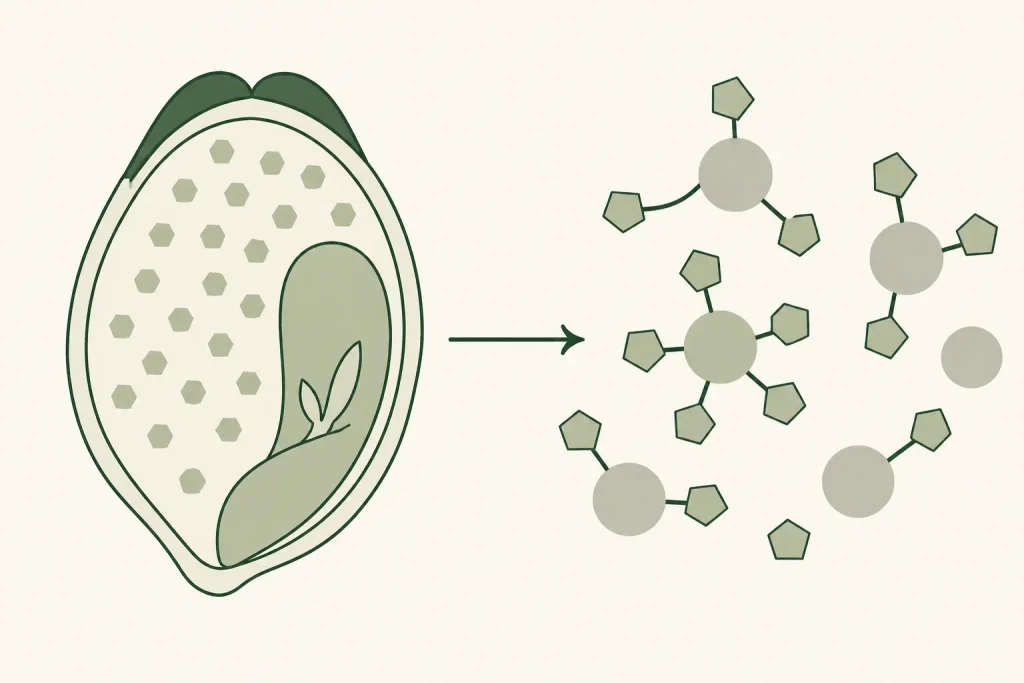
Phytate is the major storage form of phosphorus in many plant seeds.
You will often see the terms phytic acid and phytate used interchangeably in nutrition discussions.
Strictly speaking, they refer to related chemical forms whose proportions depend on the chemical environment.
For everyday nutrition communication, however, “phytic acid” is commonly used when discussing the compound in foods, while “phytate” is frequently used when discussing its mineral-binding behavior.
Phytate is particularly abundant in foods such as:
- whole grains
- beans and other legumes
- nuts
- seeds
A review of phytate in human nutrition describes its distribution in plant foods and its ability to interact with minerals and trace elements in the digestive tract.
This mineral-binding property is what makes phytate important for zinc absorption.
How does phytate affect zinc?
Here is the basic mechanism.
When phytate and zinc are present together under conditions favorable to binding, they can form relatively insoluble complexes.
That can make zinc less available for absorption in the intestine.
Phytate
can bind and reduce absorption of
Zinc
When phytate and zinc are present together under conditions favorable to binding, they can form relatively insoluble complexes. That can make zinc less available for absorption in the intestine.
A human study directly demonstrated this effect.
Researchers added different amounts of phytate to test meals and measured zinc absorption using a zinc tracer.
Without added phytate, average zinc absorption was about 34%. When enough phytate was added to produce a phytate:zinc molar ratio of 15, absorption fell to approximately 17.5%.
That’s a controlled experimental situation—not a prediction that everyone eating a high-phytate meal will absorb exactly half as much zinc.
But it demonstrates an important principle:
Phytate can substantially influence zinc absorption.
Why does the phytate:zinc ratio matter?
Researchers often look at the phytate:zinc molar ratio rather than simply asking how much phytate a food contains.
Why? Because phytate doesn’t act in isolation. The amount of zinc available matters too.
For example, a diet containing a certain amount of phytate may have a different effect if it also provides considerably more zinc.
A systematic review and meta-analysis of dietary factors affecting zinc bioavailability found that phytate was associated with lower fractional zinc absorption. Higher phytate:zinc ratios were generally associated with lower fractional zinc absorption.
However, this ratio should not be treated as a universal cutoff that tells you whether a person will become zinc deficient.
It is a research measure for describing the relationship between two dietary components. The body’s zinc status and total dietary zinc intake also matter.
Does a high-phytate diet automatically cause zinc deficiency?
No. This is one of the most important points.
A diet can contain phytate without causing zinc deficiency.
The effect becomes more important when:
- zinc intake is low
- phytate intake is high
- the diet relies heavily on plant staples
- there are additional factors affecting zinc absorption or requirements
- the overall diet provides limited sources of highly bioavailable zinc
The NIH Office of Dietary Supplements notes that people following vegetarian or vegan diets can have lower zinc bioavailability because these diets often contain larger amounts of legumes and whole grains containing phytates. It also notes that food preparation techniques such as soaking can reduce phytate binding and improve zinc bioavailability.
So the more accurate statement is:
High dietary phytate can reduce zinc absorption, particularly when zinc intake is also limited.
That is very different from saying:
“Plant foods prevent zinc absorption.”
They don’t.
What happens to phytate during food processing?
Here’s where food preparation becomes interesting.
Phytate is not completely fixed in the food. Processing can alter it.
Methods such as:
- soaking
- germination
- fermentation
- phytase treatment
- some forms of cooking and processing
can reduce phytate under appropriate conditions. This is covered in more detail in our article on how soaking and fermenting grains and beans affects mineral absorption.
A recent review of human intervention studies found that many interventions involving phytase or dephytinization improved iron and zinc bioavailability, while phytic-acid-rich foods generally reduced mineral bioavailability.
That provides additional human evidence that phytate reduction can influence mineral availability.
Can soaking beans improve zinc absorption?
It can help by reducing phytate binding.
The NIH Office of Dietary Supplements specifically mentions soaking beans, grains, and seeds in water for several hours before cooking as a food-preparation technique that can reduce the binding of zinc by phytates and increase zinc bioavailability.
But soaking is not a magic “zinc unlock.”
Its effect depends on:
- the food
- soaking time
- temperature
- water conditions
- phytase activity
- how the food is subsequently cooked
- whether soaking water is discarded
So it is better to say:
Soaking can reduce phytate and may improve zinc bioavailability.
rather than:
Soaking always increases zinc absorption.
What about fermentation?
Fermentation can be particularly interesting because microorganisms and naturally occurring enzymes can change the food’s chemical environment.
During suitable fermentation processes, phytate can be broken down.
The resulting lower-phytate food may provide a more favorable environment for mineral absorption.
The NIH notes that organic acids in fermented foods might increase zinc absorption, while also highlighting food-processing methods that reduce phytate binding.
Research reviews similarly identify fermentation as one approach that can reduce phytate and improve mineral bioavailability.
But again: fermentation does not automatically produce the same result in every food.
The microorganisms, food matrix, fermentation conditions, and starting phytate concentration all matter.
What happens when phytate is actually removed?
This is where human experiments become especially useful.
In one controlled crossover study, researchers compared a cereal-based complementary food containing its natural phytate concentration with a nearly dephytinized version.
The phytate concentration was reduced from about 4 mg/g to less than 0.03 mg/g.
The result? Apparent fractional zinc absorption increased from 22.8% to 34.6% in the dephytinized food.
This is direct human evidence that reducing phytate can improve zinc absorption.
But the study involved a specific food and controlled conditions. It does not mean that removing phytate from every food will produce exactly the same increase.
Does lower phytate always mean more zinc absorption?
Not necessarily by the same amount. The relationship is influenced by the whole meal.
Zinc absorption is regulated by the body and depends on factors including:
- amount of zinc consumed
- dietary phytate
- recent zinc intake
- zinc status
- other dietary components
Human research shows that the body can adapt to differences in dietary zinc.
In a controlled study of adults, people consuming low-zinc diets increased zinc absorption after several weeks. This adaptation was less evident when the diets were higher in phytate.
That tells us something important:
The body is not a passive container. It can adjust zinc absorption according to dietary conditions.
Does protein affect the picture?
Yes.
The interaction between phytate and zinc occurs within a larger food matrix.
Proteins and their constituent amino acids can influence mineral availability, and research has investigated how different protein sources alter zinc absorption.
This is one reason why looking at a single compound in isolation can oversimplify nutrition.
A meal is a system. The effect of phytate depends partly on what else is being eaten.
What about animal foods?
Animal foods generally provide zinc with higher bioavailability than many plant foods.
The NIH identifies meat, fish and seafood, eggs, and dairy products as good zinc sources, while noting that zinc from beans, nuts, and whole grains has lower bioavailability partly because these foods contain phytates.
That does not mean plant foods are poor sources of zinc.
It means that the fraction absorbed can differ.
This distinction matters particularly for diets that rely heavily on plant-based staple foods.
What about fortified foods?
Fortification adds another layer.
A food can contain added zinc while also containing phytate.
Research indicates that high-phytate meals can reduce fractional absorption of zinc from fortified foods, although adding zinc can still increase the total amount of zinc absorbed.
This is an important example of why:
fractional absorption ≠ total absorbed zinc.
If you consume more zinc, the percentage absorbed can fall while the actual amount absorbed still increases.
So we should be careful with statements such as:
“Only 20% was absorbed.”
That percentage alone doesn’t tell us how much zinc entered the body without knowing the amount consumed.
Is phytate always “bad”?
This is where nutrition discussions often become unnecessarily black and white.
Phytate can reduce the bioavailability of minerals such as zinc and iron.
But that does not mean phytate is simply a “toxin” that must be eliminated from the diet.
Phytate is a naturally occurring plant compound, and research has also investigated potential biological effects that are separate from its mineral-binding activity.
For nutrition education, a more useful framing is:
Phytate is a dietary compound that can reduce mineral bioavailability under certain conditions.
That’s more accurate than calling it an “anti-nutrient” and implying that foods containing it are inherently unhealthy.
Who should pay more attention to this interaction?
The phytate–zinc relationship is particularly relevant when a person’s diet relies heavily on:
- whole grains
- beans and legumes
- nuts and seeds
while providing relatively little zinc from highly bioavailable sources.
The NIH Office of Dietary Supplements specifically identifies people following vegetarian and vegan diets as a group in which zinc bioavailability can be lower because of higher phytate exposure from legumes and whole grains.
That does not mean everyone following a plant-based diet has inadequate zinc.
It means diet composition and preparation deserve attention.
What can you do with this information?
You don’t need to eliminate phytate-rich foods.
Instead, think about food preparation and dietary variety.
- Soak beans and grains — soaking can reduce phytate under suitable conditions and is already identified by NIH ODS as one technique that may improve zinc bioavailability.
- Consider fermented foods — fermentation can reduce phytate and alter the food matrix, potentially improving mineral bioavailability.
- Eat a varied diet — combining different zinc sources can help provide adequate total zinc intake.
- Don’t focus on one meal in isolation — zinc nutrition is determined by the overall diet, not by the phytate content of a single food.
- Think about bioavailability, not just nutrient numbers — a nutrition label tells you how much zinc is present. It doesn’t tell you exactly how much your body will absorb.
A simple example
Imagine a bowl containing whole grains + beans + seeds.
This meal may contain a meaningful amount of zinc. But it can also contain substantial phytate.
Now imagine preparing the grains or beans using a process that reduces phytate.
The total zinc in the ingredients may not suddenly increase. Instead, the relationship between zinc and phytate changes.
That can make a greater fraction of the zinc available for absorption.
Now add the rest of the meal. Other dietary components can alter the final absorption environment.
This is why nutrition is rarely as simple as “Food X contains zinc.”
The better question is:
“How much zinc is available, and how much can the body actually absorb?”
The bottom line
Phytate can reduce zinc absorption. It does this primarily by binding zinc in the digestive tract and forming complexes that are less available for absorption.
The effect is particularly relevant to diets rich in whole grains, legumes, nuts, and seeds. But phytate is not a reason to avoid these foods.
Instead, food preparation can change the interaction. Soaking, fermentation, and other dephytinization methods can reduce phytate, and human studies show that reducing phytate can improve zinc absorption in controlled settings.
The most important distinction is this: eating zinc ≠ absorbing zinc. And: reducing phytate ≠ automatically preventing zinc deficiency.
Your total zinc intake, the phytate:zinc relationship, food preparation, the rest of the meal, and your body’s physiological response all contribute.
So the next time you see a claim that phytate “blocks zinc,” remember: it is an interaction—not an on/off switch.
Frequently asked questions
Does phytic acid prevent zinc absorption?
No. Phytate can reduce zinc absorption, but it does not prevent all zinc from being absorbed. The effect depends on the amount of phytate, zinc intake, and the overall dietary context.
Are beans a poor source of zinc?
Not necessarily. Beans contain zinc, but the zinc has lower bioavailability than zinc from many animal foods because beans also contain phytates.
Does soaking beans remove phytate?
Soaking can reduce phytate under suitable conditions. The extent of reduction depends on the food and processing conditions. NIH ODS identifies soaking beans, grains, and seeds as a technique that may reduce phytate binding of zinc.
Does fermentation improve zinc absorption?
Fermentation can reduce phytate and may improve zinc bioavailability. However, the magnitude of the effect depends on the food and fermentation process.
Is phytate only found in grains?
No. Phytate occurs in many plant foods, particularly grains, legumes, nuts, and seeds.
Does cooking destroy phytate?
Cooking and other processing can alter phytate, but the effect varies by food and preparation method. It is therefore not accurate to assume that cooking always removes a specific percentage of phytate.
Does a high-phytate diet cause zinc deficiency?
Not automatically. Risk depends on total zinc intake, dietary pattern, physiological requirements, and other factors. Phytate becomes particularly important when zinc intake is relatively low.
Can you absorb enough zinc from a plant-based diet?
Yes, but zinc bioavailability can be lower in diets high in legumes and whole grains because of their phytate content. NIH ODS recommends attention to food preparation and overall zinc intake for people following vegetarian or vegan diets.
What is the phytate:zinc ratio?
It is a research measure comparing the molar amounts of phytate and zinc in a food or diet. Higher ratios are generally associated with lower fractional zinc absorption, but the ratio should not be treated as a universal clinical cutoff.
Does reducing phytate increase zinc status?
Not necessarily. Human studies clearly show that reducing phytate can improve zinc absorption in specific settings, but demonstrating a long-term improvement in zinc status requires longer and broader studies.
Evidence snapshot
| Phytate can bind zinc | Strong |
|---|---|
| Phytate can reduce zinc absorption | Strong human evidence |
| Higher phytate:zinc ratios are associated with lower fractional absorption | Supported by systematic review / meta-analysis |
| Dephytinization can increase zinc absorption | Direct human evidence |
| Soaking can reduce phytate binding | Supported; food-dependent |
| Fermentation can reduce phytate | Supported |
| Fermentation always increases zinc absorption | Not established |
| High-phytate foods automatically cause zinc deficiency | Not established |
| Reducing phytate automatically improves long-term zinc status | Not established |
Sources
- National Institutes of Health, Office of Dietary Supplements. Zinc — Fact Sheet for Health Professionals. ods.od.nih.gov
- Turnlund JR, King JC, Keyes WR, Gong B, Michel MC. A stable isotope study of zinc absorption in young men: effects of phytate and α-cellulose. Am J Clin Nutr. 1984;40(5):1071–1077. doi:10.1093/ajcn/40.5.1071
- Egli I, Davidsson L, Zeder C, Walczyk T, Hurrell R. Dephytinization of a complementary food based on wheat and soy increases zinc, but not copper, apparent absorption in adults. J Nutr. 2004;134(5):1077–1080. PMID 15113948
- Chondrou T, Adamidi N, Lygouras D, Hirota SA, Androutsos O, Svolos V. Dietary phytic acid, dephytinization, and phytase supplementation alter trace element bioavailability — a narrative review of human interventions. Nutrients. 2024;16(23):4069. doi:10.3390/nu16234069
- Factors that affect zinc bioavailability and losses in adult and elderly populations. Systematic review and meta-analysis. PMID 24739133
- Adaptation in human zinc absorption as influenced by dietary zinc and bioavailability. PMID 18469257
- Phytate in foods and significance for humans: food sources, intake, processing, bioavailability, protective role and analysis. PMID 19774556
- Phytate and zinc bioavailability. PMID 7712343
Subjects covered in this chapter
Continue exploring
Related interactions
Does soaking or fermenting grains and beans change how much iron you absorb?
Preparation & Meal Context
If beans, lentils or whole grains are part of your diet, you may have heard that soaking, sprouting or fermenting them makes…

Can These 5 Foods Affect How Your Body Uses Egg Nutrients?
Food + Nutrient
Black tea is the only one of the five with real human evidence - it reduced egg-protein amino-acid digestibility by about 17%…

Fat + Fat-Soluble Vitamins: Does Eating Fat Really Improve Vitamin Absorption?
Nutrient Synergy
Dietary fat genuinely improves absorption of vitamins A, D, E and K. But the relationship isn't linear — once a meal contains…