

Black tea is the only one of the five with real human evidence - it reduced egg-protein amino-acid digestibility by about 17% in a controlled study. The other four claims don't hold up the way they're usually told.
Quick answer
You may have seen claims that eggs should not be eaten with foods such as soy milk, tea, sugar, bananas, or meat. But the science is more nuanced.
Black tea is the clearest exception. A small controlled human study found that drinking black tea with a meal containing whole boiled eggs reduced the true digestibility of indispensable amino acids from the egg protein by about 17%. Tea polyphenols appear to be involved in this interaction.
Soy is more complicated. Research shows that certain soy proteins can reduce non-heme iron absorption, but that is very different from saying that soy milk prevents your body from absorbing egg protein. There is no good evidence that eating eggs and soy milk together causes a “protein overload.”
For sugar, bananas, and meat, there is no convincing evidence that simply eating them with eggs makes the egg nutrients unavailable or creates a harmful digestive combination.
So the real lesson isn’t that eggs have a list of forbidden food pairings. It is that some foods can interact with specific nutrients or components of a meal—but those interactions are usually much more specific than social-media-style food-combination rules suggest.
Eggs are nutrient-dense—but what happens when you pair them with other foods?
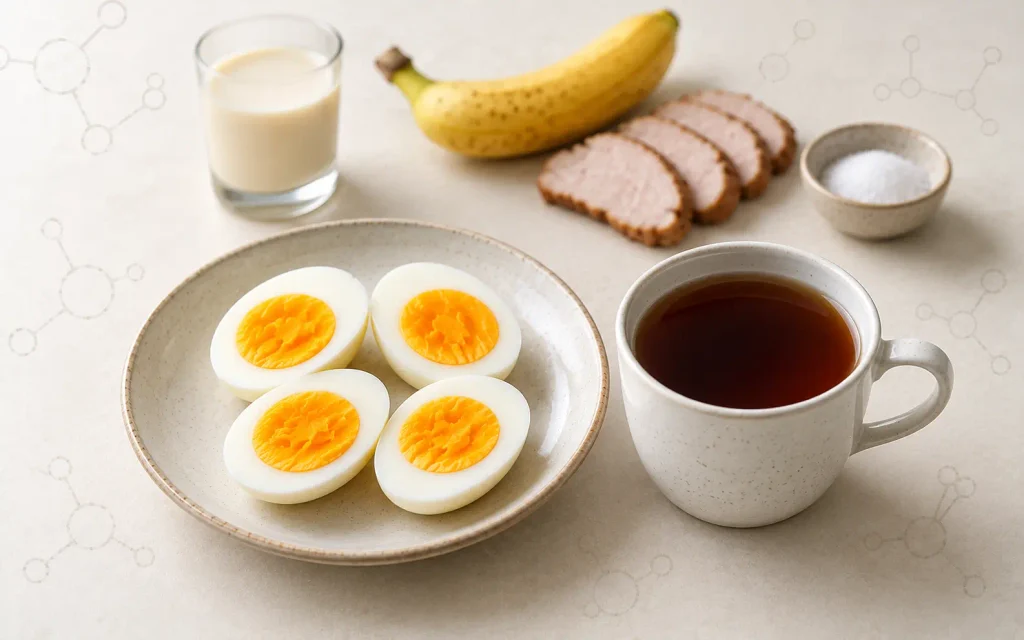
Eggs are one of the most nutrient-dense foods commonly eaten.
They provide high-quality protein along with nutrients such as choline, vitamin B12, selenium and vitamin D, although the exact nutrient profile varies with the egg and production system.
The NIH Office of Dietary Supplements lists eggs among important food sources of choline and vitamin B12. One large hard-boiled egg provides about 147 mg of choline, while a large cooked egg provides about 0.5 mcg of vitamin B12.
Egg protein is also highly digestible.
In a human study using stable-isotope techniques, true ileal digestibility of whole boiled egg protein was approximately 89%. Cooked egg protein has also been shown to be substantially more digestible than raw egg protein in earlier human research.
That raises an interesting question:
Can another food eaten in the same meal actually change what happens to those nutrients?
Sometimes, yes. But not in the simplistic way many food-combination articles suggest.
1. Soy milk: does it block egg protein absorption?
The claim
Some articles claim that combining soy milk with eggs creates too much protein for the digestive system and prevents the body from properly absorbing the amino acids.
What does the evidence say?
There is no good evidence that eating eggs and soy milk together creates a “protein overload” that prevents protein absorption.
Your digestive system is designed to digest mixed meals containing multiple protein sources.
Research in humans shows that different protein sources can have different digestion and amino-acid absorption kinetics, but this does not mean that combining them makes the proteins unusable.
In one human study, soy protein was digested and absorbed effectively, with a true oro-ileal digestibility of about 91%.
Another study comparing protein sources found that soy and milk proteins produced different post-meal amino-acid kinetics, but these differences reflected differences in digestion and metabolism—not an inability to absorb the proteins when consumed as food.
But there is a real soy–nutrient interaction
Here’s where the story gets more interesting.
Soy products can contain compounds that influence non-heme iron absorption.
A controlled human study found that isolated soy protein and several soy products reduced absorption of non-heme iron in the test meals.
That does not mean soy milk blocks the nutrients in eggs.
It means that, depending on the meal composition, soy can influence the absorption of non-heme iron.
That distinction matters because nutrient interactions are often nutrient-specific, rather than affecting the entire nutritional value of a meal.
Verdict: mostly myth
Eating eggs with soy milk is not inherently a bad combination. The evidence does not support the idea that your digestive system becomes overloaded with protein. However, soy products can influence non-heme iron absorption in certain meal contexts.
2. Tea: the one pairing worth paying attention to
The claim
Drinking tea with eggs may reduce the body’s ability to digest and use egg protein.
This one actually has human evidence behind it.
What does the research show?
A controlled study published in The Journal of Nutrition examined what happened when healthy Indian adults consumed whole boiled egg with black tea.
The researchers used a dual-isotope tracer technique to measure the true digestibility of indispensable amino acids.
The result?
Black tea
reduced digestibility of
Egg protein
True indispensable amino acid digestibility of whole boiled egg protein decreased by approximately 17% when black tea was consumed with the meal. The researchers attributed the effect to interactions between tea polyphenols and protein.
This is important because it is not simply a theoretical laboratory observation. It was measured in humans using a sophisticated tracer method.
Does that mean you should never drink tea with eggs?
Not necessarily.
The study was small, involving only five adults in the egg comparison, and it tested a particular black tea dose and meal composition.
So it should not be interpreted as:
Tea makes eggs unhealthy.
Instead, the more precise conclusion is:
Black tea can reduce the digestibility of egg protein when consumed with the meal, at least under the conditions studied.
Tea can also affect non-heme iron absorption more broadly. Human studies have repeatedly shown that tea polyphenols can inhibit non-heme iron absorption, particularly when tea is consumed with an iron-containing meal.
This may be more relevant for people who already have low iron intake or are at risk of iron deficiency.
What about coffee?
Coffee also contains polyphenols and can reduce non-heme iron absorption.
Human research has found substantial reductions in non-heme iron absorption when coffee is consumed with meals.
So this isn’t really an “egg + tea” problem. It is an example of a broader principle:
Beverages can sometimes change nutrient absorption depending on what is in the meal.
Verdict: supported—with important limitations
This is the strongest of the five claims. Black tea can reduce the digestibility of egg protein in a controlled human study, and tea can also inhibit non-heme iron absorption. But that does not make tea and eggs a dangerous combination.
3. Sugar: does eating sugar with eggs create harmful compounds?
The claim
Some articles claim that sugar reacts with the amino acids in eggs and creates harmful compounds that may interfere with digestion or increase blood-clotting risk.
This claim mixes together a real chemical reaction with an unsupported conclusion about eating eggs and sugar together.
The real chemistry: glycation
Sugars can react non-enzymatically with proteins.
This is part of the chemistry behind glycation and the formation of advanced glycation end products, or AGEs.
These reactions can occur during food preparation and also within the body.
Cooking conditions matter greatly. High temperatures, dry heat and longer cooking times can promote the formation of dietary AGEs, particularly in foods rich in protein and fat.
But this is very different from saying:
“Eating sugar with eggs creates harmful compounds in your stomach.”
There is no good evidence that simply consuming a sweet food alongside eggs causes a special digestive reaction that makes the egg nutrients unavailable.
The chemistry of glycation is influenced by factors such as temperature, time, moisture, pH and the chemical environment—not simply whether two foods were eaten during the same meal.
What about blood clotting?
The claim that eating sugar with eggs creates a combination that increases blood clotting is not supported by the evidence reviewed for this article.
That should not be confused with the broader evidence around excessive intake of added sugars and overall dietary quality.
The current Dietary Guidelines emphasize nutrient-dense foods and limiting foods and beverages higher in added sugars, saturated fat and sodium.
That’s a dietary-pattern recommendation—not a warning against eating eggs and sugar in the same meal.
Verdict: unsupported as an egg-pairing claim
Sugar can participate in glycation chemistry, particularly during cooking and processing. But there is no convincing evidence that eating sugar with eggs creates a unique harmful reaction or prevents your body from absorbing egg nutrients.
4. Banana: does eating eggs with a banana slow digestion?
The claim
Another common claim is that eggs and bananas are both “heavy” foods that take a long time to digest, so eating them together supposedly causes bloating, sluggish digestion or constipation.
What does the evidence say?
There is no established physiological rule that eggs and bananas should not be eaten together.
Your digestive system does not need foods to be eaten according to separate “digestion times.” Mixed meals are normal.
Eggs provide protein and fat, while bananas provide carbohydrate, fiber and micronutrients. The digestive system processes these components using coordinated mechanical and chemical digestion.
The idea that combining a protein-rich food with a carbohydrate-rich food causes the digestive system to become overloaded is not supported by the evidence reviewed for this article.
In fact, research on mixed meals demonstrates that different macronutrients are routinely digested and absorbed together, although the presence of fat, protein, fiber and food structure can influence gastric emptying and nutrient kinetics.
Could someone feel uncomfortable after eating eggs and bananas?
Yes—but that doesn’t establish that the combination itself is harmful.
Individual tolerance can vary.
A person may experience bloating or fullness after a large meal for many reasons, including portion size, total fat or fiber intake, eating speed, food intolerance, or the rest of the meal.
That’s very different from saying:
“Eggs + bananas = poor digestion.”
Verdict: no convincing evidence
There is no good evidence that bananas need to be separated from eggs to protect digestion or preserve egg nutrients.
5. Meat: is eating eggs with meat too much protein?
The claim
Because eggs and meat both contain protein and fat, some articles claim that eating them together overloads digestion and slows metabolism.
The science tells a different story
Eggs and meat are both high-quality protein foods.
Human research has measured the ileal digestibility of egg and meat proteins directly. In one study, true ileal indispensable amino acid digestibility was approximately:
| Whole boiled egg | 89.4% |
|---|---|
| Cooked meat | 92.0% |
These foods were highly digestible protein sources.
There is no established physiological mechanism by which eating these two protein foods together suddenly makes the digestive system unable to process them.
In fact, mixed meals commonly contain multiple protein sources.
The more relevant question is what kind of meat and how much of it you’re eating.
A meal containing eggs, vegetables and a modest serving of lean meat is nutritionally very different from a large meal containing eggs, bacon, sausage, fried potatoes and other foods high in saturated fat and sodium.
The Dietary Guidelines’ current framework emphasizes nutrient-dense protein foods and encourages attention to foods higher in saturated fat and sodium.
So the issue is much more about the overall meal pattern than an incompatibility between eggs and meat.
Verdict: mostly myth
There is no good evidence that eggs and meat become difficult to digest simply because they are eaten together. The nutritional quality of the overall meal matters much more.
So, which egg pairings actually matter?
After looking at the evidence, the original list looks very different.
| Food paired with eggs | Does it interfere? | What the evidence suggests |
|---|---|---|
| Black tea | Possibly | Human study found ~17% lower egg-protein amino-acid digestibility |
| Soy milk / soy | Not egg protein specifically | Soy can reduce non-heme iron absorption in some meal contexts |
| Sugar | No specific egg-pairing evidence | Glycation is real, but the “egg + sugar” claim is overstated |
| Banana | No convincing evidence | No established harmful egg-banana interaction |
| Meat | No | Both are highly digestible protein sources; overall meal composition matters |
The important distinction is between a food affecting a specific nutrient and a food making an entire meal “bad.”
Nutrition rarely works that simply.
The bigger lesson: nutrient interactions are more specific than food-combining rules
This is where food-pairing claims can become misleading.
A food does not necessarily make another food “undigestible.”
Instead, particular compounds can interact with particular nutrients.
For example:
- Tea polyphenols — can interact with proteins and inhibit non-heme iron absorption.
- Soy components — can reduce non-heme iron absorption under certain conditions.
- High-temperature cooking — can promote formation of dietary AGEs.
But none of these statements means:
“Never eat these foods together.”
The actual effect depends on the food matrix, dose, cooking method, nutrient involved, the rest of the meal and the person’s nutritional status.
This is why nutrition science uses terms such as digestibility, bioavailability and absorption rather than simply labeling foods as “good” or “bad combinations.”
What should you actually do?
For most people, there is no reason to build a complicated list of foods that must never be eaten with eggs.
Instead, focus on the overall meal.
If you drink tea with breakfast
If you’re concerned about maximizing egg-protein digestibility—or especially if you’re trying to optimize iron absorption—consider having your black tea separately rather than drinking it with the meal.
Human research suggests that separating tea from an iron-containing meal can reduce its inhibitory effect on non-heme iron absorption.
If you enjoy eggs with soy
There’s no reason to assume the protein will become unavailable.
Just remember that soy can influence non-heme iron absorption in certain meal contexts.
If you like eggs and bananas
You don’t need to separate them simply because of a supposed digestion rule.
If you eat eggs with meat
Pay more attention to the overall meal composition—particularly the amount of processed meat, saturated fat and sodium—than to the fact that eggs and meat are being eaten together.
If you add sugar
The bigger nutritional question is how much added sugar your overall diet contains, not whether sugar happened to be eaten during the same meal as an egg.
The bottom line
So, can these five foods affect how your body uses egg nutrients? Sometimes—but the answer isn’t “avoid all five.”
Black tea has the strongest evidence: a controlled human study found that consuming black tea with whole boiled egg reduced the digestibility of indispensable amino acids from egg protein by about 17%.
Soy is more nuanced. Soy products can interfere with non-heme iron absorption, but that doesn’t mean soy milk blocks the protein or other nutrients in eggs.
For bananas, meat and sugar, the popular claims about harmful egg combinations aren’t supported by convincing evidence.
The bigger lesson is more useful than a list of foods to avoid: your body doesn’t follow simple food-combination rules. It responds to nutrients, compounds, food structure, cooking methods and the entire meal.
So rather than asking “Which foods should never be eaten with eggs?” a better question is: “Does this particular food change the absorption or digestion of a particular nutrient?” That’s where the science becomes much more interesting.
Frequently asked questions
Can I drink tea after eating eggs?
You can. There is no evidence that tea and eggs form a dangerous combination. However, a controlled human study found that black tea consumed with a whole-egg meal reduced egg-protein indispensable amino-acid digestibility by about 17%.
If maximizing nutrient absorption is particularly important to you, separating tea from the meal is a reasonable strategy.
Can I eat eggs and soy milk together?
Yes. There is no evidence that combining them causes a protein “overload.” Soy can, however, reduce non-heme iron absorption in some meal contexts.
Is it bad to eat bananas with eggs?
There is no convincing evidence that bananas and eggs are an inherently bad combination or that they need to be separated for digestion.
Can I eat meat and eggs together?
Yes. Eggs and meat are both highly digestible protein sources. Human research has measured high ileal digestibility for both cooked egg and meat proteins.
The overall nutritional quality of the meal matters more than combining these two protein foods.
Does sugar react with egg protein inside the stomach?
The body can undergo glycation reactions, and sugars can participate in reactions with proteins. Food processing and high-temperature cooking can also promote the formation of advanced glycation end products.
But there is no good evidence that simply eating sugar and eggs together causes a special harmful reaction in the stomach.
Does tea reduce iron absorption from eggs?
Tea polyphenols can inhibit non-heme iron absorption. Eggs contain some non-heme iron, but the practical importance of this interaction depends on the rest of the meal and the person’s overall iron intake and status.
Are eggs difficult to digest?
Cooked egg protein is generally highly digestible. Human studies have found substantially greater digestibility for cooked egg than raw egg protein.
How comfortable a person feels after eating eggs can still vary depending on portion size, cooking method, total meal composition and individual tolerance.
Evidence snapshot
Strongest evidence
Black tea can reduce egg-protein amino-acid digestibility in humans under controlled conditions.
Moderate / context-dependent evidence
Soy products can inhibit non-heme iron absorption, but this does not establish that soy milk blocks egg protein absorption.
Established chemistry, but misleading application
Sugar and proteins can participate in glycation reactions, particularly during cooking and processing. This does not establish a harmful “egg + sugar” interaction during digestion.
Insufficient evidence
There is insufficient evidence to conclude that eating eggs with bananas creates poor digestion.
Insufficient evidence
There is insufficient evidence to conclude that eating eggs with meat overloads the digestive system or makes the proteins poorly absorbed.
Sources
- National Institutes of Health, Office of Dietary Supplements. Choline — Fact Sheet for Health Professionals. ods.od.nih.gov
- National Institutes of Health, Office of Dietary Supplements. Vitamin B12 — Fact Sheet for Health Professionals. ods.od.nih.gov
- U.S. Department of Agriculture. FoodData Central. fdc.nal.usda.gov
- Kashyap S, Shivakumar N, Varkey A, Preston T, Devi S, Kurpad AV. Co-ingestion of black tea reduces the indispensable amino acid digestibility of hens’ egg in Indian adults. J Nutr. 2019. doi:10.1093/jn/nxz091
- Kashyap S, Shivakumar N, Varkey A, Duraisamy R, Thomas T, Preston T, Devi S, Kurpad AV. Ileal digestibility of intrinsically labeled hen’s egg and meat protein determined with the dual stable isotope tracer method in Indian adults. Am J Clin Nutr. 2018;108(5):980–987. doi:10.1093/ajcn/nqy178
- Cook JD, Morck TA, Lynch SR. The inhibitory effect of soy products on nonheme iron absorption in man. Am J Clin Nutr. 1981. PMID 7198374
- Dietary factors and non-heme iron absorption. PMID 11029010
- Evenepoel P, Geypens B, Luypaerts A, Hiele M, Ghoos Y, Rutgeerts P. Digestibility of cooked and raw egg protein in humans as assessed by stable isotope techniques. J Nutr. 1998. PMID 9772141
- Inan-Eroglu E, et al. Formation of advanced glycation endproducts in foods during cooking process and underlying mechanisms. Nutr Res Rev. 2020. PMID 31699165
- U.S. Department of Health and Human Services and U.S. Department of Agriculture. Dietary Guidelines for Americans, 2025–2030. dietaryguidelines.gov
Subjects covered in this chapter
Continue exploring
Related interactions
Phytate + Zinc: How Does Phytic Acid Affect Zinc Absorption?
Food + Nutrient
You can eat a food that contains zinc and still absorb less of it than you might expect. One reason is phytate.…

Fat + Fat-Soluble Vitamins: Does Eating Fat Really Improve Vitamin Absorption?
Nutrient Synergy
Dietary fat genuinely improves absorption of vitamins A, D, E and K. But the relationship isn't linear — once a meal contains…
Vitamin D + Calcium: How Does Vitamin D Affect Calcium Absorption?
Nutrient Synergy
Without vitamin D you absorb 10–15% of dietary calcium; with enough, 30–40%. But a one-year trial found that pushing levels higher raised…