

Without vitamin D you absorb 10–15% of dietary calcium; with enough, 30–40%. But a one-year trial found that pushing levels higher raised absorption by 1% — about 10 mg of calcium a day.
This is the most firmly established nutrient interaction in the Atlas. Without vitamin D, your body absorbs only a small fraction of the calcium you eat. With enough of it, absorption roughly triples.
That relationship is textbook physiology, not a contested finding. It is also the reason the two nutrients appear together on supplement labels, in fortified milk, and in nearly every conversation about bone health.
But there is a second finding, equally well established and far less often repeated:
Once you have enough vitamin D, taking more does not meaningfully increase calcium absorption. In a one-year randomized trial, high-dose vitamin D raised calcium absorption by 1% — about 10 mg of calcium a day.
Vitamin D behaves like a threshold, not a dial. Crossing it matters enormously. Climbing past it does very little.
So the useful question is not “Does vitamin D help me absorb calcium?”
It is:
“Do I have enough vitamin D for the system to work — and what happens if I have more than enough?”
Quick answer
Vitamin D is required for efficient calcium absorption. Without it, roughly 10–15% of the calcium in your food is absorbed. With adequate vitamin D, that rises to about 30–40%.
It works through its active hormonal form, which switches on the transport machinery in the intestinal wall that carries calcium across. This is a genuine dependency, not a modest enhancement — it is why severe vitamin D deficiency causes rickets and osteomalacia.
But the effect saturates. In a randomized trial in postmenopausal women with insufficient vitamin D, raising blood levels above 30 ng/mL increased calcium absorption by just 1% and produced no improvement in bone density, muscle function or falls.
And in more than 25,000 generally healthy adults, five years of vitamin D supplementation did not reduce fractures.
The evidence supports correcting a deficiency, not maximizing an intake.
Interaction at a glance
| What interacts | Vitamin D and dietary calcium |
|---|---|
| Direction of effect | Enabling — vitamin D is required for efficient calcium absorption |
| Where it happens | Utilisation and absorption: activation in the liver and kidney, then transport across the small intestine |
| Size of effect | About 10–15% of dietary calcium absorbed without vitamin D; about 30–40% with it |
| What it depends on | Vitamin D status, calcium intake, age, parathyroid hormone, kidney function |
| Shape of the relationship | A threshold, not a dose-response curve |
| Evidence | Mechanism and deficiency effect well established; benefit of supplementing beyond sufficiency not established |
| Upper limit matters | Yes — vitamin D toxicity causes hypercalcemia precisely because it drives calcium absorption |
| Big distinction | Correcting a deficiency ≠ increasing an intake |
What are calcium and vitamin D?

Calcium
Calcium is the most abundant mineral in the body. The overwhelming majority sits in bone and teeth, where it provides structure. The small remainder circulating in blood and inside cells does something arguably more urgent: it enables muscle contraction, nerve signalling, blood clotting and hormone release.
That division explains a great deal about how the body behaves. Blood calcium is held within a narrow range at almost any cost — and if dietary calcium is short, the skeleton is the reserve that gets drawn on.
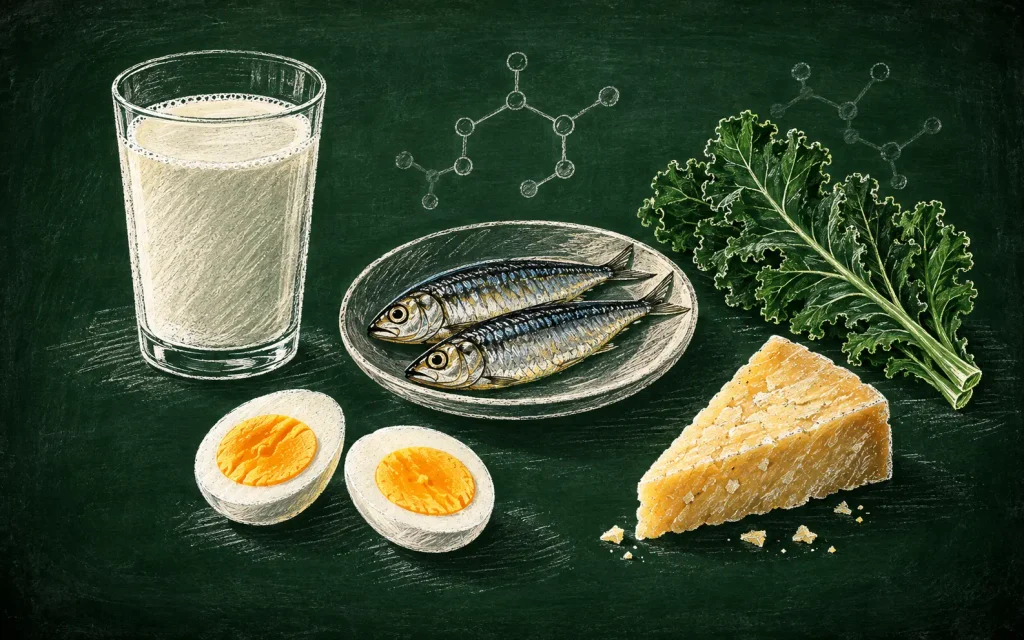
Dietary sources include dairy products, fortified plant milks and juices, canned fish with soft bones, tofu set with calcium, and some leafy greens.
Vitamin D
Vitamin D is unusual among vitamins in that the body can make it, in skin exposed to ultraviolet light. It is also unusual in that it functions less like a vitamin and more like a hormone.
What arrives from sunlight, food or a supplement is inert. It has to be converted twice before it does anything — a detail that matters for this interaction and for a separate one, since those conversion enzymes depend on magnesium.
Food sources are limited: oily fish, egg yolks, some mushrooms, and fortified foods, of which fortified milk is the most significant in many countries.
How the interaction works
Vitamin D
switches on absorption of
Calcium
Vitamin D does not carry calcium into the body. It instructs the cells lining the small intestine to build the machinery that does — which is why the relationship reads as a switch rather than a lever.
The full sequence runs through three organs before any calcium moves.
- Skin or diet — inert vitamin D enters the bloodstream.
- Liver — converts it to 25-hydroxyvitamin D, the form measured in a blood test.
- Kidney — converts that into 1,25-dihydroxyvitamin D, the active hormone.
- Intestine — the hormone binds its receptor and switches on genes for calcium transport proteins.
- Absorption — calcium crosses the intestinal wall and enters the blood.
The critical point sits at step four. The active hormone acts on gene transcription. It tells intestinal cells to manufacture the channels and carrier proteins that move calcium across. Without that instruction, the machinery is simply not built, and most dietary calcium passes through unabsorbed.
This is what separates the vitamin D–calcium relationship from most interactions in the Atlas. Vitamin C helps iron stay soluble. Phytate binds zinc. Those are chemical events in the gut lumen. Vitamin D is not interacting with calcium at all — it is changing what your intestinal cells are capable of.
There are two routes, and only one needs vitamin D
Calcium crosses the intestinal wall by two mechanisms, and the distinction explains several things that otherwise look contradictory.
| Active transport | Through the intestinal cells, using transport proteins built on vitamin D’s instruction. Saturable, efficient, and dominant when calcium intake is low. |
|---|---|
| Passive diffusion | Between the cells, driven by concentration. Largely independent of vitamin D, and dominant when a large amount of calcium is present at once. |
Two consequences follow.
First, vitamin D matters most when calcium intake is low — exactly when efficient absorption is most needed. The active route is the one that rescues a marginal intake.
Second, because the active route saturates, taking a very large amount of calcium at once is inefficient. NIH guidance notes that absorption is most efficient at doses of around 500 mg or less at a time, which is why calcium supplements are often recommended in divided doses.
The numbers
The commonly cited figures are stark. In the absence of vitamin D, roughly 10–15% of dietary calcium is absorbed. In its presence, absorption rises to about 30–40%.
Phosphorus follows a similar pattern, moving from around 60% to about 80%.
Even at its best, then, most of the calcium you eat is not absorbed. That is normal. Fractional absorption of around a third is what a healthy system looks like — not a sign of malfunction.
It is also why the consequences of severe deficiency are so visible. Insufficient vitamin D reduces calcium absorption, which contributes to osteoporosis over time and, in extreme cases, to rickets in children and osteomalacia in adults.
The part most articles leave out: more is not better
If deficiency cuts absorption to a third of normal, it seems to follow that more vitamin D should push absorption higher still.
It has been tested directly, and it does not.
Hansen and colleagues randomised 230 postmenopausal women with insufficient vitamin D — blood levels between 14 and 27 ng/mL — to placebo, a low dose, or a high dose that reliably pushed levels above 30 ng/mL. They measured calcium absorption directly, using two stable isotopes, over a full year.
Calcium absorption in the high-dose group rose by 1%. In absolute terms, about 10 mg of calcium per day.
There were no differences between groups in spine, hip, femoral neck or total-body bone density, in muscle mass, in sit-to-stand or timed-up-and-go performance, or in falls. The authors concluded that they found no data supporting recommendations to maintain blood levels of 30 ng/mL or higher in postmenopausal women.
A separate year-long dose-response trial reached a similar place from a different direction. Gallagher and colleagues found that the absorption gain from 4,800 IU of vitamin D per day amounted to roughly the calcium in a small glass of milk.
A statistically significant effect and a practically meaningful one are different things. This interaction produces both — the first when correcting deficiency, the second only then.
Why the body pushes back
The saturation is not an accident. Calcium absorption is actively regulated, and the regulator is parathyroid hormone.
When blood calcium falls, parathyroid hormone rises. It signals the kidney to produce more of the active form of vitamin D, which increases calcium absorption in the intestine and calcium reabsorption in the kidney. When blood calcium is adequate, that signal quiets down.
In other words, the system already adjusts itself. Supplying more raw vitamin D to a body that is not short of it does not force the loop to run harder — the loop is not being limited by supply.
This is the same pattern the Atlas keeps encountering. Iron absorption is regulated by need, which is why vitamin C’s dramatic single-meal effect fades across a whole diet. Bodies are not passive containers.
What does the evidence show?
Well established
Vitamin D is required for efficient calcium absorption. The mechanism is understood at the level of gene transcription, deficiency reduces absorption to roughly a third of normal, and severe deficiency causes recognised bone disease. Correcting a genuine deficiency restores absorption.
Depends on context
How much any individual gains depends on where they start. Someone deficient has a great deal to gain; someone already sufficient has very little. There is also evidence that in older adults who are genuinely insufficient in both nutrients, modest replacement doses of vitamin D with calcium reduce hip fracture risk — a different situation from supplementing people who are already replete.
Not supported
Supplementing vitamin D in people who are not deficient does not appear to improve bone outcomes. In VITAL, more than 25,000 generally healthy adults took 2,000 IU daily for around five years, and vitamin D did not reduce total or hip fractures. Baseline vitamin D level did not change that result, and neither did taking calcium alongside it.
What the evidence does not show
Specifically, this research does not establish:
- that higher vitamin D levels produce stronger bones in people who already have adequate levels
- that a specific blood level above sufficiency should be targeted — the trial designed to test that question found no support for it
- that vitamin D supplements prevent fractures in the general population
- that taking calcium and vitamin D together is necessary for the calcium to work, if vitamin D status is already adequate
- what the optimal level is for people with osteoporosis, severe deficiency or malabsorption — the large trials deliberately excluded or under-represented them
That last exclusion is important and is often lost when trial results are summarised. VITAL studied generally healthy adults not selected for deficiency, low bone mass or osteoporosis. Its finding is about that population. It is not evidence that vitamin D is irrelevant to someone who is genuinely deficient.
Context matters
Two people, same supplement, very different situations.
Person A
- little sun exposure, covered skin or a northern winter
- few fortified foods in the diet
- modest calcium intake
- a genuinely low blood level
Here the interaction is doing real work. Correcting the deficiency moves absorption from the low range toward the normal one — a substantial change in how much calcium actually reaches the body.
Person B
- regular outdoor time
- fortified milk or oily fish in the diet
- adequate calcium intake
- a blood level already in the sufficient range
Here the machinery is already switched on. Adding more vitamin D changes absorption by an amount measured in single-digit milligrams per day, and the trials find no improvement in bone density or fracture risk.
The same intervention. Wildly different value. That gap is the entire practical content of this interaction, and it is invisible if you only ask whether vitamin D “helps with calcium.”
The direction that gets ignored: too much
Most nutrient interactions have a floor to worry about. This one also has a ceiling, and it exists for exactly the reason the interaction is useful.
Because vitamin D increases calcium absorption, vitamin D toxicity produces hypercalcemia — too much calcium in the blood. NIH notes this typically occurs at blood 25(OH)D levels above roughly 150 ng/mL, far beyond anything achievable from food or sunlight.
Hypercalcemia can cause nausea, vomiting, muscle weakness, excessive thirst and urination, and kidney stones. In severe cases it can lead to kidney failure, calcification of soft tissues including blood vessels and heart valves, and cardiac arrhythmias.
Reported cases have come from manufacturing errors, inappropriate dosing, and incorrect prescribing — not from sun exposure or ordinary diet.
The mechanism that makes vitamin D essential at low doses is the same one that makes it harmful at very high ones. That is not a paradox — it is what a dose-dependent hormone looks like.
Intake, absorption and status
| Calcium intake | How much calcium is in the food you eat. Vitamin D does not change this. |
|---|---|
| Calcium absorption | The fraction that crosses into the body. This is what vitamin D governs, and where the 10–15% versus 30–40% figures apply. |
| Calcium status | Blood calcium is tightly regulated and stays near-normal even when intake is poor — because bone is the buffer. A normal blood calcium reading does not mean calcium intake is adequate. |
That third row deserves emphasis. With most nutrients, a blood test reflects status. With calcium, the body will dismantle the skeleton to keep the blood number normal — so the reassuring result and the underlying problem can coexist for years.
Practical takeaway
Vitamin D and calcium genuinely depend on each other, and the dependency is not subtle: without enough vitamin D, most of the calcium you eat passes straight through.
But the useful framing is sufficiency, not maximisation. The evidence supports having enough vitamin D. It does not support pushing levels higher in the hope of absorbing more calcium — that has been tested, and the gain amounted to about 10 mg of calcium a day.
For most people the practical questions are ordinary ones: whether the diet supplies enough calcium in the first place, and whether sunlight, fortified foods or oily fish are supplying enough vitamin D to keep the system running.
Whether you are deficient is a question a blood test answers and an article cannot. If you are considering supplements — particularly at higher doses, or alongside a condition affecting the kidneys, parathyroid glands or calcium handling — that decision belongs with a clinician who can test rather than infer.
Frequently asked questions
Does vitamin D increase calcium absorption?
Yes, substantially. Without vitamin D roughly 10–15% of dietary calcium is absorbed; with adequate vitamin D that rises to about 30–40%. It works by switching on the transport proteins in the intestinal wall that carry calcium across.
Will taking more vitamin D help me absorb more calcium?
Not once you have enough. A one-year randomised trial found that raising blood levels above 30 ng/mL increased calcium absorption by 1%, or about 10 mg of calcium a day, with no improvement in bone density, muscle function or falls. The relationship behaves like a threshold rather than a dose-response curve.
Do I need to take calcium and vitamin D at the same time?
They don’t need to be in the same mouthful. Vitamin D works by maintaining a blood level of the active hormone and by changing what intestinal cells produce, which is an ongoing state rather than a single-meal chemical reaction. What matters is having adequate vitamin D status, not the timing relative to a calcium-containing meal.
Should calcium supplements be split into smaller doses?
Absorption efficiency falls as the amount of calcium taken at one time rises, because the active transport route saturates. NIH guidance notes that doses of around 500 mg or less are absorbed most efficiently, which is why larger daily amounts are often divided.
Do vitamin D supplements prevent fractures?
Not in the general population, according to the largest trial to test it. In VITAL, more than 25,000 generally healthy adults took 2,000 IU daily for about five years, and vitamin D did not reduce total or hip fractures — including among those who also took calcium. That trial did not include people selected for osteoporosis or severe deficiency, so it does not answer the question for them.
Can you get too much vitamin D?
Yes, from supplements. Because vitamin D drives calcium absorption, toxicity causes hypercalcemia — high blood calcium — which can lead to kidney stones, soft-tissue calcification and, in severe cases, kidney failure. This typically involves blood levels far above the normal range and has been linked to manufacturing errors and inappropriate dosing, not to sunlight or diet.
Does a normal blood calcium test mean I’m getting enough calcium?
No. Blood calcium is held within a narrow range regardless of intake, drawing on the skeleton when dietary calcium is short. A normal reading tells you the regulatory system is working, not that your intake is adequate.
Does age change how much calcium I absorb?
Absorption efficiency is highest during infancy and growth and declines with age, and older adults also convert vitamin D less efficiently and often get less sun exposure. These factors compound, which is why the interaction receives particular attention in older populations.
Does this interaction relate to any others?
Two in particular. The enzymes that convert vitamin D into its active form are magnesium-dependent, so magnesium status sits upstream of this whole pathway. And calcium itself can reduce iron absorption when both are in the same meal — a separate interaction with a different mechanism.
Sources
- National Institutes of Health, Office of Dietary Supplements. Vitamin D — Fact Sheet for Health Professionals. ods.od.nih.gov
- National Institutes of Health, Office of Dietary Supplements. Calcium — Fact Sheet for Health Professionals. ods.od.nih.gov
- Hansen KE, Johnson RE, Chambers KR, Johnson MG, Lemon CC, Vo TNT, Marvdashti S. Treatment of vitamin D insufficiency in postmenopausal women: a randomized clinical trial. JAMA Intern Med. 2015;175(10):1612–1621. doi:10.1001/jamainternmed.2015.3874
- LeBoff MS, Chou SH, Ratliff KA, et al. Supplemental vitamin D and incident fractures in midlife and older adults. N Engl J Med. 2022;387(4):299–309. doi:10.1056/NEJMoa2202106
- Dawson-Hughes B. Effect of vitamin D on risk of falls and fractures — the contribution of recent mega-trials. Metabol Open. 2024;23:100300. doi:10.1016/j.metop.2024.100300
- Vitamin D. StatPearls. National Library of Medicine. ncbi.nlm.nih.gov/books/NBK441912
- Gallagher JC, et al. Dose-response study of vitamin D supplementation and calcium absorption in postmenopausal women with vitamin D insufficiency. PubMed.
- U.S. Department of Agriculture. FoodData Central. fdc.nal.usda.gov
Subjects covered in this chapter
Continue exploring
Related interactions

Fat + Fat-Soluble Vitamins: Does Eating Fat Really Improve Vitamin Absorption?
Nutrient Synergy
Dietary fat genuinely improves absorption of vitamins A, D, E and K. But the relationship isn't linear — once a meal contains…

Can These 5 Foods Affect How Your Body Uses Egg Nutrients?
Food + Nutrient
Black tea is the only one of the five with real human evidence - it reduced egg-protein amino-acid digestibility by about 17%…
Phytate + Zinc: How Does Phytic Acid Affect Zinc Absorption?
Food + Nutrient
You can eat a food that contains zinc and still absorb less of it than you might expect. One reason is phytate.…